
KinchStalker
-
Joined
-
Last visited
Posts posted by KinchStalker
-
-
The following is sourced from "大木とキムの殴りこみで"プロレス日韓戦争"開始", an article written by Seibu Kikuya and published in the November 1976 issue of Monthly Pro Wrestling, pg. 78-81. It has been rewritten and rearranged for clarity and flow.
OKI AND KIM'S ASSAULT STARTS "JAPANESE-KOREAN PRO WRESTLING WAR"
Kim Il (Kintaro Oki) and Kim Duk (Masanori Toguchi), the Korean master-disciple duo, are set to face Giant Baba and Jumbo Tsuruta in the final match of the AJPW Giant Series at the Kuramae Kokugikan on October 28. The catalyst for this was a written challenge from Oki, sent from Korea, for the International Tag Team titles held by Baba and Tsuruta.
In summary, the letter read:
“On May 13, at the Kawasaki City Gymnasium, Oki and Nankaizan [Kang Sung-Yung] had the opportunity to face Baba and Tsuruta, albeit in a non-title match, but they were unsuccessful. Fortunately, Oki now has Kim Duk as his partner and will challenge Baba and Tsuruta again for the tag titles. Masanori Toguchi, aka Kim Duk, has grown into a young warrior after three years of training in the US, and has gained the ability and popularity to surpass Oki. We are confident that he will be able to show his Japanese fans how well he has matured, and that he will be able to capture the title. We hope that Baba and Tsuruta will graciously accept this challenge.”
Baba was surprised. After hearing from Samson Kutsuwada and others that Oki was not in a condition to perform, Baba had decided to postpone the first show of the Giant Series at Omiya, where Oki was scheduled to wrestle. The reason was that Oki had been scheduled to defend his Asian Heavyweight title against Waldo von Erich.
Baba said, "Anyway, I am worried about Mr. Oki's injury and his injury, and I don't have enough information about Toguchi.” He immediately inquired at the PWF headquarters about Toguchi's eligibility to challenge, but the reply was withheld, saying that a decision would be made after Mr. Oki's arrival in Japan. This seemed to have irritated Oki again. On September 20, Oki arrived in Japan with Toguchi. The flight from Seoul to Tokyo usually takes less than two hours, but this was quite unusual for him, as he usually arrived at the airport just before the opening of the show.
Oki flies in with bandages, saying the challenge comes before the cure
Baba was understandably concerned about Oki's injury. Oki had just been seriously injured in a car accident.
 It was after 11:00 p.m. on August 31 when Oki was involved in a traffic accident. Oki was on his way home from a dinner with friends outside of Seoul when he collided head-on with a cab as he was approaching Han River Road on Route 3. Oki, who was riding in the front passenger seat, was rushed to Soonchunhyang Hospital in Namsan, Seoul, after he crashed through the front windshield and became a bloody mess. He suffered lacerations on the forehead, face, right elbow, and right palm, as well as bruises all over his body. He was seriously injured, with a projected recovery time of one month. The most severe injury was the forehead laceration, for which a combined plastic and reconstructive surgery was performed by cutting and grafting about nine square centimeters [approx. 3.5”] of skin from the right thigh. If Oki hadn't had the world's hardest head, trained by head-butting, he might have been killed. On the night of his hospitalization, Oki had a high fever of 39 degrees Celsius and could not sleep at all.
However, on September 5, the sixth day of his hospitalization, Oki ignored the doctor's protests and forcibly discharged himself from the hospital, before his stitches had been removed. This was because a four-show domestic tour was set to begin on September 8. The tour featured freelance wrestler Thunder Sugiyama and All Japan wrestlers Samson Kutsuwada, Kazuo Sakurada, Mitsuo Momota, and Atsushi Onita. On September 8, they had scheduled an afternoon show in Incheon and an evening show in Seoul. Shows in Daegu and Pyeongtaek would follow on the 9th and 11th. Oki participated on all shows with his head heavily bandaged, as if he were wearing a white mask.
On September 8, Oki returned to the ring to wrestle Thunder Sugiyama.
“Not only could I not use my head butt, but my right hand and right leg didn’t work as well as they should. However, I was prepared to die in the ring," said Oki. In Korea, a wrestling show without the "hero" Kim Il would not be possible. Fans come to the event to see Oki. For his fans, Oki risked death in the ring. But this was not a good thing for his wounds. He had broken all the doctor's injunctions, “not to move and not to sweat”. It is only natural that Baba, who heard the report of Kutsuwada and others after their return to Japan, was concerned about the extent to which Oki had recovered. Oki countered. "I challenged because I was confident that I could win. I did not issue the challenge before I was injured. I don't need Baba's concern about my injury."
He was so irritated by the lack of response that he stormed into Japan four days before the tour was set to begin. Oki and Toguchi held a press conference at the Rio coffee shop in Shibuya on the 20th, at 6 p.m. His head was still bandaged and the lacerations on his nose and the corners of his eyes had not fully healed, but he spoke in a passionate tone. Oki expressed regret for the worry he had caused to his Japanese fans in the car accident, and after explaining why he had challenged Toguchi to be his partner in the inter-tug, he vented his anger: “It's been more than a week and I still haven't received a reply. I have also written to PWF President Lord [James] Blears, but he has not responded either. I've been trying to negotiate with these slow-moving men by letter and phone from Seoul, but I just can't seem to get anywhere, so here I am. As the last Inter Tag Team Champion when I was with Japan Pro Wrestling [alongside Umanosuke Ueda], of course I have the right to challenge for the title, and I can't adjust Kim Duk's schedule if I don't hear back from him soon. If I don't get a decision by the end of the day, I will not participate in the Giant Series. I'll send Toguchi back to the U.S. tomorrow, and I'll go back to Seoul.”
All Japan external relations head [Ryozo] Yonezawa, who was attending the press conference at Oki's request, panicked.
"We have been in touch with Blears again and again," Yonezawa said. "Blears said that he had no problem with Mr. Oki's qualifications for the challenge. However, we are still gathering information on Mr. Oki's nominee, Kim Duk, who is a part-timer. I think we should have reached a conclusion by now, but the truth is that we are aware of Masanori Toguchi of Nippon Pro-Wrestling, but we do not have enough information on Kim Duk.”
When Yonezawa explained the reason for the delay, Toguchi snapped at Yonezawa: "That's ridiculous. I have experience in the United States. If you call the American promoter, you can find out right away." The bearded Toguchi, who had grown two sizes since before he came to the U.S., had an impressive body and face. After a heated exchange of opinions, Oki escalated the conditions to "either Tokyo, Osaka, or Nagoya," and the day ended with a promise from All Japan to give a definite answer by 3:00 p.m. tomorrow, the 21st.
Kim Duk, who grew up in Tokyo and devoted himself to Oki
Some of you may be wondering why Oki's letter of challenge refers to Toguchi as "[his] successor," so I will explain the relationship between Oki and Toguchi.
Born in Kanamachi, Katsushika-ku, Tokyo in 1948, Toguchi was a promising young judoka when he was a student at Shutoku High School. However, Toguchi had been fascinated with Oki, a "hero" born in his parent’s homeland of Korea, since his boyhood. He tried to drop out of high school and enter professional wrestling, but Oki gave him counsel, and since then he had come to look up to Oki as an older brother and a mentor, consulting him on everything. When Toguchi was scouted by Masahiko Kimura, the director of the Takudo University judo club, Toguchi visited Oki at the Taito Gymnasium with Mr. Kimura, asking to see Oki. At that time, Oki asked Kimura, "Please help Toguchi to become a judo champion in Japan," and recommended that Toguchi also be under Kimura's care.
However, upon his graduation in March 1967, Toguchi "made up his mind" to join Japan Pro Wrestling. He flew to Korea to become a trainee at the Kim Il Dojo, which at the time was located in a secret garden in Seoul. After six months of training under Oki, Toguchi made his debut as a young Japanese wrestler in August 1968. Toguchi therefore said, "At Japan Pro, Mr. Oki and I would have been considered senior and junior, but I consider Mr. Oki my mentor. I would do anything for my respected teacher.”
Toguchi's expression is not an exaggeration. In October of last year, Toguchi appeared in Korea for a week. When he received a call from Oki asking him to participate in a mock teardown of the newly built Bunka Gymnasium and Kim Il Dojo in Seoul, he left Minneapolis for Japan to take a flight to Seoul, not even stopping long enough to visit his parents.
Toguchi had arrived in the U.S. in December 1972, near the end of the Japan Pro era. At that time, the promotion could not afford to send out young talented wrestlers for hakutsuke, so Toguchi's trip to the U.S. was entirely due to Oki's consideration. Toguchi received a red gown with gold tiger embroidery that Oki had worn, and he went to the States by himself. He says that he had a hard time without food and drink in America. However, Toguchi rose quickly last year after he entered the AWA and was recognized by its king, Verne Gagne. He had been scheduled to challenge for the AWA World Championship for the first time in November, having beaten the best of the best.
Kim Duk's schedule was tight as he had become so popular. However, when Toguchi received a call from Oki, he said, "It's thanks to Oki-san that I became a star in America. For Oki-san's sake, I am willing to give up my chance to challenge the AWA title." He forcefully canceled his AWA dates schedule, the most important period for a wrestler before his first challenge, and flew to Korea.
Toguchi's trip to Japan this time was also "for the sake of the general”. Toguchi, who had played an active role in the Korean series from September 8 in helping a seriously injured Oki, was scheduled to fly to the North Carolina territory instead of stopping in Japan. However, Toguchi was worried about Oki's condition in the Giant Series even though he was still recovering from a serious injury. When he was told of Oki's regret over his defeat by Baba and Tsuruta in May in a team with Nankaizan, Toguchi decided to go with him, and cancelled his bookings.
Oki and Kim crash the opening ceremony of All Japan's new dojo.
A fight that was sold, and a showdown in Kuramae.
September 21, when the master-disciple duo of Oki and Toguchi were forced to make a definite decision, was also the opening day of All Japan’s newly built training camp and dojo in Setagaya, Tokyo. It was just after 3:00 p.m. The priest officiated the dojo opening without incident, but just as the attendees were relaxing, Oki and Toguchi arrived. For a moment, there was an atmosphere of ill will. Oki's face stiffened up as he read the schedule of the Giant Series Championships handed to him by Yonezawa.
Oki pressed Baba. “Abdullah [the] Butcher and Waldo von Erich’s challenge is already on the schedule," he said. “What will happen if the foreign team wins, if we are going to challenge the winners of the Neyagawa title match on October 24? You've got to beat us first!”
Baba responded. “Are you challenging for the titles, or are you challenging us? We can't change our previous agreement with the Butcher's group.”
Oki decided. "Okay! There’s no point in challenging the foreigners. Even if you lose, I'll still challenge you. Nagoya or Tokyo!”
Oki's challenge continued. The Nagoya show on the 22nd, held at the Aichi Prefectural Gymnasium, had already booked its main event: the sixth in Jumbo Tsuruta’s ten-match Trial Series, against the Butcher. Meanwhile, the October 28th show at Tokyo’s Kuramae Kokugikan had scheduled a PWF Heavyweight championship match between Baba and Butcher. After consulting with NTV officials, Baba had agreed to face Butcher at the Kuramae Kokugikan, as if he had been sold a fight.
Oki's face lit up, and he turned his focus toward Tsuruta, who had been following Baba closely. Pointing at Toguchi, he said “Can't you even greet your senpai?” Toguchi was more than four years Tsuruta's senior. Tsuruta, however, who had been watching Oki's fighting and snapping at his mentor, glared silently at Oki and Toguchi. Meanwhile, Toguchi was dressed in trunks.
“Show him how strong you are.” At the sound of Oki’s voice, Toguchi stepped into the ring, from which the altar had just been cleared. “Ito, let him have it!” Baba shouted angrily, but [Masao] Ito was no match for Kim Duk. Atsushi Onita followed him, and was also lightly beaten. Kim then performed a blockbuster drop [translator's note: Japanese term for fallaway slam], shoulderbuster, dropkick, human windmill [re:butterfly suplex], and various other moves. Tsuruta was so shocked that he ran to the ring in his shirt. The Great Kojika, Kazuo Sakurada, and others rushed to restrain him. As Oki reminded Kim that today was the dojo’s opening, he stopped, and the situation deescalated.
Tsuruta and Kim grab each other at the doorway to start the series of fights.
The confrontation at the dojo opening was only a minor one, but the "fight" between the Japanese and Korean master-disciple duo got into full swing in the opening show of the tour.
It was September 24, in Omiya. Oki had been challenged by Erich for his Asian Heavyweight title in the main event, but he was not yet in full fighting condition. With the Butcher’s intrusion, the match was declared null and void. Kim, trying to protect Oki, got into a showy brawl with the Butcher, but when Baba entered the ring to stop it, Kim said, “Why are you coming in here?” A furious Baba was responded in kind. “Because you’re all sloppy,” he said. “If you’re going to be such a lousy face, then leave!” This time, Oki got angry. “What? If that’s so, then I’ll settle things with you right now.” He challenged Baba, but Japan Pro’s representative, [former JWA president Junzo] Yoshinosato, intervened, and the matter was settled.
However, this was not the end of the story. Kim, who was on his way back to the special waiting room after helping Oki, bumped into Tsuruta in the hallway. Eye to eye, they grabbed each other at the same time. It was a loud exchange of karate and punches. All the young men came to the scene and finally separated the two fighters, but this was the decisive moment between Tsuruta and Kim.
The next day, the Japanese and Korean master-disciple duos fought each other at every turn. They were always separate in the waiting room and in their behavior, and whenever they looked at each other, they were fighting each other. The cool-headed Baba always kept his composure, but the bloodthirsty Oki, and the young Toguchi and Tsuruta kept their heads in the sand. The young players had no time to relax, lest Tsuruta and Toguchi get together. If they met, they would run amok.
With the Butcher and The Destroyer joining the fray, the Giant Series, filled with a deadly atmosphere, is running toward the final show, which will be an explosive battleground.
Tsuruta meets Kim Duk, his first 'native' rival.
-
Posted ·
Edited by KinchStalker
increased font size for better readability
[Credit to this Igapro article for most of this information.]
Flagship NJPW program World Pro Wrestling entered a turbulent period in 1983. As Tiger Mask departed and unmasked in August, after he and manager Shunji Koncha had disagreed with the plans for a coup, the ratings began to fall under 20%. The UWF and Japan Pro Wrestling departures followed in 1984; the latter chunk was so devastating that TV Asahi had to hold a press conference to make it clear that World Pro Wrestling would continue. The popularity of the Machine Army and the acquisitions of Bruiser Brody, Shiro Koshinaka, and Kevin & Kerry von Erich had brought some hope, but AJPW’s return to prime time and the end of New Japan’s WWF partnership were a devastating pair of blows. While the NJPW/UWF feud is now regarded by puroresu fans as a creative high point of Showa period New Japan, and partnerships with Calgary booker Tetsunosuke Daigo and Bill Watts’ Mid-South brought new foreign blood into the company, by the autumn of 1986 there had been talk of dropping the program outright.
This was tempered by NJPW chairman Hiroshi Tsujii and managing director Takahira Nagasato. Both men were TV Asahi executives who had received those seats in the network takeover of 1983, and both mens’ careers were deeply linked to World Pro Wrestling in particular. In 1969, when the JWA sought a second network deal to sabotage the chances of the Great Togo’s tentatively named National Wrestling Enterprise, Tsujii was the executive they approached. Nagasato, meanwhile, had overseen the program as the head of the network’s sports department. It was agreed, though, that change was necessary. World Pro Wrestling was shifted to the same time on Mondays, a timeslot it had previously held for much of its original run as a Japan Pro Wrestling/JWA program. The change began on October 13, 1986, but would only last six months.
The program was preempted by other programming on several occasions, which had not been an issue on the Friday timeslot. Masa Saito’s first match in NJPW since 1984, a singles bout against Inoki, was thrown out due to the interference of a hockey-masked pirate. This angle had been set up when Keiji Mutoh was attacked by a man in this costume in Tampa, but according to the kayfabe-breaking book by referee Mr. Takahashi, Victor Manuel had misunderstood his assignment and handcuffed the wrong man to the rope. It was a disaster.
By this point, the network agreed that “major surgery” was necessary to save the program. World Pro Wrestling received a grand, 90-minute sendoff on April 6 before the new era began, as the rebranded and retooled I Can’t Wait Until The Give Up!! World Pro Wrestling began airing at 8pm the following night. This had previously been the timeslot of the popular variety show Beat Takeshi’s Sports Taisho, and this matter warrants a digression.
An infamous incident involving top TV Asahi entertainer "Beat" Takeshi Kitano (pictured here in 1982) would lead NJPW to a brief, disastrous television experiment.
Beat Takeshi’s Sports Taisho saw the titular entertainer and his two groups of tarento apprentices, the Takeshi Corps and Takeshi Corps Sepia, compete in sports against teams that would consist of audience members, fellow entertainers, or professional athletes. The program had suffered a mortal wound after a December 1986 incident. When a reporter for weekly tabloid FRIDAY approached Takeshi and a much younger vocational student that he was suspected to be dating on the streets of Shinjuku, he sprained her neck and back as he shoved his tape recorder in her face and yanked her by the hand. Around 3am that night, Takeshi and various Corps/Corp Sepia members stormed FRIDAY’s headquarters, brandishing umbrellas and a fire extinguisher and assaulting five employees. As Takeshi awaited his trial, he and his accomplices withdrew from their entertainment activities, and the renamed Sports Taisho was left to make do with the few Takeshi Corps members who hadn’t been involved.
With both World Pro Wrestling and Sports Taisho in decline, TV Asahi decided to retool the former into a wrestling-variety hybrid program in the timeslot of the latter, hoping they could broaden NJPW’s appeal. This new program would be produced by the network’s variety department instead of its sports wing. Response within NJPW was mixed, as Inoki was surprisingly supportive, but Seiji Sakaguchi opposed it. Meanwhile, Weekly Pro Wrestling reporter Fumihiko “Fumi” Saito was brought on as a writer and filter for the variety department’s ideas.
I Can’t Wait Until The Give Up!! didn’t try to ease old fans into the new format. Kuniko Yamada and Kenichi Nagira were hosts, and other entertainers include idols LaSalle Ishii, Togumi Otoko and Kaoru Shimura, as well as actor and wrestling fan Reo Morimoto. The show was set up so that such celebrities could play to a studio audience and provide guest commentary on the wrestling. Segments in the premiere promoted Bam Bam Bigelow with a promo video and a segment comparing his weight to that of audience members, while Masa Saito entered the studio to challenge Inoki. All the while, though, the camera crew favored the celebrities in their close-ups. The backlash was immediate, as a dismal 5.7% debut fell to a 5.0% the next week. The studio and idol elements were soon dropped in favor of studio interview segments. It was after this change, though, that the most famous incident of the I Can’t Wait Until The Give Up!! experiment took place. Yamada interviewed Hiroshi Hase, a Japan Pro Wrestling recruit who had completed his debut excursion but had not yet debuted for NJPW. Kuniko asked a dumb question about whether a bleeding wrestler ceased to bleed when they returned to the waiting room (if I’m parsing it correctly, it seems to imply that she thought they used fake blood), and an agitated Hase snapped at her. While the likes of Inoki and Tatsumi Fujinami understood the difficulty of Yamada’s position, and they sympathized as her awareness of viewer backlash took a toll on her well-being, many others must have felt that Hase had spoken for them in that moment.
In July, the studio element was dropped and other planned variety show segments were shelved. However, this experiment would reverberate in the company for years. When Beat Takeshi returned to TV Asahi, he got involved with NJPW as the head of a faction which played off of the Corps, Takeshi Puroresu Gundan. And while one member of that group, Leon White, had been scouted by New Japan before the I Can’t Wait Until The Give Up!! experiment, the Vader gimmick and helmet prop, were vestiges of an idea from that period to create a gimmick that would appeal to shonen fans. (For those unaware, the Vader costume was a Go Nagai commission.)
While his debut came months after I Can't Wait Until The Give-Up! had been abandoned, Big Van Vader was partially its offspring.
-
-
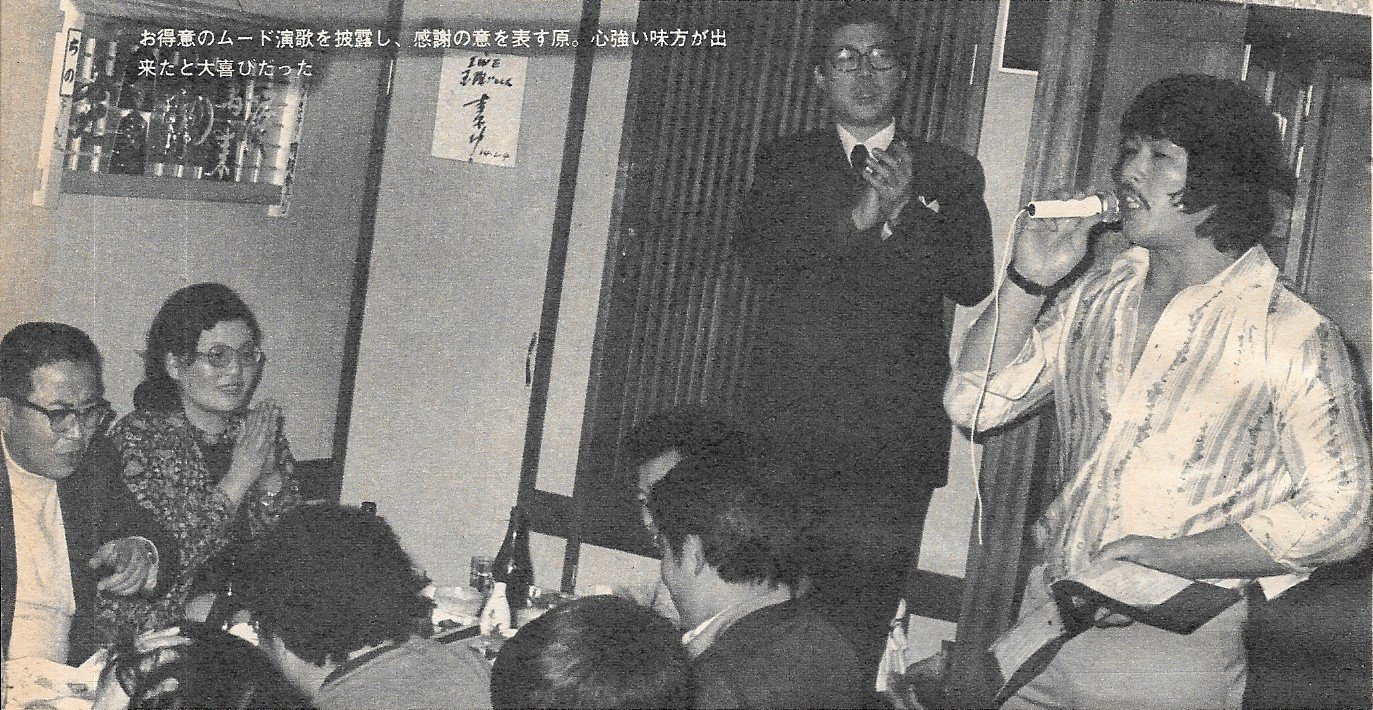
The following is translated from a column in the March 1978 issue of Monthly Puroresu.

Charity concert featuring Tsuruta and other vocalists
Whenever he had free time during his regional tours, he would visit nursing homes and other places of comfort. Despite his appearance, Jumbo Tsuruta has a strong spirit of volunteerism. On March 1, he will hold a charity concert at the "Ruido" restaurant in Shinjuku, Tokyo.
Last September, Tsuruta held a "Songs for Young People" charity concert. This will be the second time he has held such an event, but this time it will not be just for his friends. This time, he would like to invite professional singers and hold a joint concert with them.
Of course, when he says "invite professional singers as guests", he doesn't mean popular celebrities such as Mr. Hiroshi Itsuki, Ms. Yoshiko or Ms. Momoe [Yamaguchi].
When he says, "I can only sing folk songs, and I would like a folk singer as a guest singer," it seems that he has been considering Sakura Kono, who is a longtime fan of Tsuruta himself and also sings folk songs.
He also said that he would like Baba to sing a song at the event, and all the young wrestlers of All Japan Pro, including Onita and Sonoda, are scheduled to appear on stage. About 20 disabled boy fans will be invited to the event, and they will sing for about two hours, so please cheer them on, dear readers.
-
-
Korakuen Hall
Capacity: 2,005*
Background
Completed in 1962, the Korakuen Bowling Hall opened a Korakuen Gymnasium on its fifth and sixth floors. It was Japan’s first such venue without windows. In 1967, it was renamed Korakuen Hall; the bowling alley was moved and replaced with a roller rink six years later. The exterior has been remodeled four times, most recently after the 2011 Tōhoku earthquake. The venue continues to see regular use for combat sports, and the fact that Korakuen provides its own ring is an attractive one to boxing promoters. It also serves as a dance hall, as its floorboards meet the specifications for competitive dance. After the construction of JCB Hall in 2008, the Tokyo Dome Corporation lowered Korakuen’s rental fee.
Wrestling
Korakuen held its first wrestling show on November 25, 1966, with Giant Baba defeating Luis Hernandez. Besides an April 1970 show by the IWE, the JWA sabotaged its competitors’ attempts to run the building, until AJPW booked it in November 1972. After the JWA’s collapse, Korakuen opened up to all of puroresu, including AJW. In the late 1980s, Weekly Pro Wrestling editor and Baba creative consultant Tarzan Yamamoto put Korakuen at the center of his strategy to revitalize All Japan. The quality of AJPW’s Korakuen shows in this era, best represented by the 1991 Fan Appreciation Day event and its revered Super Generation Army/Tsurutagun six-man tag, were foundational to the venue’s modern mythos. As it has become more affordable for indies to run, the consistency and attendance of a company’s Korakuen shows are often gauged as a shorthand for their current status.
*AJPW frequently announced capacity crowds of 2,100 in the early 90s. However, claimed attendance figures from previous years go as high as 3,400, such as All Japan’s January 18, 1981 show featuring Baba’s 3000th match against Verne Gagne.
-
Riki Sports Palace
Capacity: 3,000
Background
The Riki Sports Palace wasn’t the first venue Rikidōzan built; the Rikidozan Dojo/Japan Pro Wrestling Center predated it by several years. As the Dojo became eyed for public appropriation, though, Rikidozan decided to build a larger venue in Shibuya. It would be a permanent home for pro wrestling: the Kuramae of puroresu. Modeled after the Honolulu Civic Auditorium, Rikidozan spent 1.5 billion yen to build the Riki Sports Palace, which was completed in 1961. On some level, the Palace was a practical investment, as it gave the JWA a consistent base in Tokyo while eliminating the need to rent a venue in the market. Unfortunately, the Palace bloated into a symbol of its namesake’s hubris and poor business acumen, from offices and dojos to a sauna and a bowling alley. After Rikidozan’s death, the Palace became an albatross around the JWA’s neck in the eyes of an executive council that sought to cut ties with the debt-ridden Riki Enterprises. While sales manager Isao Yoshihara attempted to buy it from Riki Enterprises, Kokichi Endo sabotaged this. As Yoshiwara left to eventually form the IWE, the Palace was seized as collateral by its creditor. After spending much of its life as a cabaret theater, the former Palace was demolished in 1992; its atrium and the piping that had been installed for its sauna made it impossible to convert into an office building.
Wrestling
The Riki Sports Palace was regularly used by the JWA for five years. The Palace held its final show on September 23, 1966.
-
Kuramae Kokugikan
Capacity: 12,000
Background
With the Ryogoku Kokugikan closed off to them, the Sumo Association began the construction of a new venue in 1949, on a plot of land they had purchased in 1941. While the Kuramae Kokugikan was officially completed in September 1954, it was used for sumo as early as 1950, and in fact its earliest brush with pro wrestling predates its completion. Plans were made to rebuild Kuramae to double capacity in the mid-sixties, but they were abandoned as sumo’s popularity declined. The venue was closed in 1984, with a sale to the Tokyo city government helping fund the construction of its successor, the second Ryogoku Kokugikan. It is now used as an office by the city sewage department.
Wrestling
From Rikidozan and Masahiko Kimura’s first battles with the Sharpe Brothers in February 1954, to Inoki vs. Choshu in August 1984, the Kuramae Kokugikan might have more history with mens’ puroresu than any building in the country, standing or otherwise. There are so many that rattling off even a few would be silly, but suffice it to say that, if you were promoting a big match in Tokyo, especially in the last decade or so before its decommissioning, and if you could work it around the sumo schedule , it was quite likely that you were going to book Kuramae.
Unlike the modern Ryogoku Kokugikan, which uses an elevator system to retract the sumo ring when not in use, Kuramae forced wrestling and boxing events to set their rings directly atop the dohyō. This provided a unique opportunity for heels, who could grab and weaponize the sand and soil below them; it also made scheduling a show tricky, because the dohyō needed a week to be filled and hardened back up after a wrestling event. Unfortunately, it also prevented joshi promotions from booking Kuramae, due to the Sumo Association’s policy banning women from stepping onto the sumo ring. While Mildred Burke had been allowed to run the venue back in 1954, this courtesy was apparently not extended to her Japanese successors. For this reason, Kuramae shows also didn’t feature bouquet girls (or so I've read it claimed; I have seen contradictory examples).
-
Denen Coliseum
Capacity: 10,000
Background
Opening in 1936, Denen Coliseum was an outdoor venue associated with the Denen tennis club; to commemorate its opening, Bill Tilden came to play a match. From hosting the Davis Cup in 1955 to a decade hosting the Japan Open Tennis Championship, the Coliseum was used for its original purpose for many years. Over time, though, it would also become notable as a music and wrestling venue. Denen closed in 1989 amidst housing development plans, having been functionally replaced by the Ariake Coliseum.
Wrestling
Denen and wrestling went back to 1956, when Rikidozan defended the fictitious Pacific Coast title against Tom Rice on September 1. Three years later, he defended his International Heavyweight title in a World League final rematch against Mr. Atomic. The brainchild of sales manager Hiroshi Iwata, the masked Mr. Atomic was specifically designed to target a younger audience, as a response to the beginnings of tokusatsu television with Gekko Kamen. As attendee Kosuke Takeuchi recalled, a ticket to the Denen show cost just fifty yen for children.
As far as puroresu is concerned, though, Denen is far more famous for a series of matches and moments from the late 70s through the early 80s. The first of these was Jumbo Tsuruta’s NWA United National title defense against Mil Mascaras, on August 25, 1977. The “idol showdown”, as it was known, remains one of AJPW’s most iconic early matches. Denen even saw a sequel of sorts, as Baba & Jumbo defended their NWA International Tag Team titles against Mascaras & Dos Caras on August 24, 1978. On September 23, 1981, NJPW treated Denen to Stan Hansen’s final singles match against Andre the Giant, commonly considered one of the greatest foreigner vs foreigner matches in puro history. That same show saw the beginning of the Kokusai Ketsumeigun invader angle, as ex-IWE stars Rusher Kimura and Animal Hamaguchi hit the ring to declare war. Other notable incidents include Tsuruta’s May 22, 1984 NWA title challenge against Kerry von Erich, and Mitsuharu Misawa’s debut as the second iteration of Tiger Mask three months later.
-
Ryogoku Kokugikan/Nihon University Auditorium
Capacity: 10,000
Background
After three years of construction, the Ryogoku Kokugikan was completed in the spring of 1909. Designed by architect Tatsuno Kingo, its neo-Baroque influences were in keeping with Kingo’s other major works, such as the Bank of Japan and Tokyo Station. The Kokugikan would be rebuilt twice due to fires in 1917 and 1923. In 1944, the venue was seized by the Imperial Japanese Army and converted into a balloon bomb factory. After the Kokugikan was heavily damaged by the Great Tokyo Air Raid of March 1945, the sumo association was allowed to hold their June tournament there, albeit as a private event for wounded soldiers. Seized once again by the occupational authorities in October 1945, the Kokugikan was renovated. The following November, the Kokugikan held its final sumo tournament. By the time the occupation ended, the Kuramae Kokugikan was already in use and since there was no room to install parking lots in Ryogoku, the sumo association sold it to Kokusai Stadium in 1952. Six years later, it was acquired by Nihon University and renamed as its auditorium. It would remain in use until revisions in building code took effect in the late 1970s, as its roof was deemed too old to support a sprinkler system. The building was officially closed in 1982 and dismantled the following year, after further revisions made sprinkler systems mandatory for large venues.
Wrestling
The Torii Oasis Shriners Club tour of 1951, generally (if reductively) considered the start of puroresu, began with a show in the Kokugikan on September 30. One month later, it ran the venue again, featuring the debut of Rikidozan. While the Kokusai Stadium period saw the company install a roller rink, the Kokugikan saw continued use for wrestling and boxing events, and this would persist into Nihon University’s ownership. At some point Nippon Television acquired exclusive rights to run the venue, and its last wrestling events were all AJPW shows. Most notably, the Auditorium held the December 5, 1974 show on which Giant Baba defeated Jack Brisco to win the NWA World Heavyweight title.
-
Tokyo
The capital of Japan, and the capital of puroresu, Tokyo is one of wrestling’s greatest cities. This thread will explore its rich history through profiles of its major wrestling venues across the decades.
Major Venues
Ryogoku Kokugikan/Nihon University Auditorium (1909-1982)
Denen Coliseum (1936-1989)
Kuramae Kokugikan (1950-1984)
Riki Sports Palace (1961-1966)
Korakuen Hall (1962-)
Nippon Budokan (1964-)
Ryogoku Kokugikan [II] (1985-)
Tokyo Dome (1988-)
Differ Ariake (2000-2018)
-
Masio Koma (マシオ駒)
Real name: Hideo Koma (駒秀雄)
Professional names: Hideo Koma, Atsuhide Koma, Kakutaro Koma, Mr. Koma, Masio Koma
Life: 5/18/1940-3/10/1976
Born: Setagaya, Tokyo, Japan
Career: 1961-1976
Promotions: Japan Wrestling Association, All Japan Pro Wrestling
Height/Weight: 172cm/100kg (5’8”/220 lbs.)
Signature Moves: Dropkick
Titles: NWA World Middleweight [EMLL] (1x), NWA United States Tag Team [Gulf Coast Championship Wrestling] (2x, with the Great Ota/Gantetsu Matsuoka), NWA Western States Tag Team [Western States Sports] (2x, with Mr. Okuma/Motoshi Okuma)As a wrestler, Masio Koma has a humble legacy marked by some territorial success. However, he was an important figure in AJPW's early years, and his unexpected death is regarded by colleagues and journalists as a turning point in company history.
Hideo Koma's athletic background was in baseball, which he played through high school as a teammate of Sadaharu Oh. Upon his graduation, Koma joined the JWA in June 1961. Debuting on October 11 with a loss to Mitsu Hirai, Koma would become Giant Baba's first valet. Like his successor Motoshi Okuma, Koma would remain loyal to Baba for the rest of his life. Hideo's early years would see him booked under his real name, and then as Atsuhide and Kakutaro Koma.
In January 1970, Koma embarked on a pioneering excursion to EMLL. On August 28, he became the first Japanese wrestler to win Mexican gold, defeating El Solitario for the NWA World Middleweight title. Koma even won it as a technico! In a 2008 web column, journalist and lucha expert Tsutomu “Tomas” Shimizu (AKA Dr. Lucha) claimed that Mexican fans of a certain generation were as likely to name Koma as the greatest Japanese foreigner to wrestle in Mexico as they were Sayama. Two years later, Shimizu would rank Koma as the fourth greatest “Japanese luchador” (based on their Mexican runs, not necessarily as "lucharesu" wrestlers), behind Ultimo, Sayama, and Hamada at #1. After this, Koma traveled north to begin work as a US territorial heel, teaming with his peers Okuma and Gantetsu Matsuoka to tag success in the Florida and Amarillo territories. It was during his run in the latter that he and Okuma were recruited by Baba for All Japan Pro Wrestling. Koma has been cited in multiple narratives as the crucial man in getting Dory Funk Sr. to agree to a partnership with Baba.
Koma became the first head coach of the AJPW dojo. Deeply respected by Baba, enough so that he could comfortably raise objections to him, Koma was also assigned as the handler of Jumbo Tsuruta. Alongside Sato, Koma gave Tsuruta about four months of part-time instruction as Tsuruta completed his baccalaureate. Koma would also teach Tsuruta locker room etiquette and acted as a buffer between Tsuruta and the resentment of his peers. Koma would successfully produce three wrestlers: Atsushi Onita, Masanobu Fuchi, and Kazuharu Sonoda. He was also involved in training Kyohei Wada. However, his poor health led AJPW to hire US-based wrestler and former IWE trainer Matty Suzuki as a wrestler and coach for extended periods in 1974 and 1975. Koma died of liver failure in 1976.
Koma's training methods were reformed by Akio Sato in the early 1980s, as Nippon Television ordered the company to begin producing more native talent. The story of Naoki Takano, a pre-Sato graduate (and cousin of George and Shunji) whose career ended in a horrific training injury just months after his debut, suggests that such reforms were warranted. Not everyone agrees, though. The Great Kabuki has claimed that Koma's death "ruined" All Japan. Koma had incorporated "gachinko" (Japanese term for shoot) fundamentals into the curriculum. Not only did AJPW fail to produce a homegrown wrestler from Sonoda's 1975 debut until Shiro Koshinaka's graduation in 1979, but the gachinko tradition was lost in favor of an Americanized, "passive" house style influenced more by the Funks than by puroresu. Kabuki remarks that "they all became weak". NJPW head trainer Kotetsu Yamamoto had been a good friend of Koma's, and he would later reveal that they consulted each other about their methods. Would Koma have developed his method further had he lived? Would the stylistic gap between AJPW and NJPW have become narrower? Whatever the case, Koma was one of AJPW's most important early figures, and although Great Kojika claims that the company culture became "lighter" after his death. It has also been cited as a destabilizing incident behind the scenes. It may have led Tsuruta to become closer to Samson Kutsuwada, which complicated Jumbo’s relationship with Baba after the 1977 incident.
-
This will either be the final or penultimate post. The final chapter is an examination of the Shitenno's legacy, and I may or may not share some of that stuff. Apologies for the formatting inconsistencies, I have no idea how to resolve them.
2019 FOUR PILLARS BIO: CHAPTERS 25-31, PART SIX
There isn’t much that Ichinose brings to the story behind AJPW’s first Dome show. There’s nothing he says that you couldn’t read in Eggshells or contemporaneous Observers. I guess I could bring up that Kobashi had “mixed feelings” about Baba saying that Misawa vs. Kawada was AJPW’s best match in a press conference. Ichinose seems to frame the Halloween 1998 Misawa/Kobashi match as Kobashi’s response to this. Also, it’s made very clear that Baba would never truly put Kawada ahead of Misawa in the pecking order, due to their junior-senior relationship. I’m going to skip the rest of the stuff about the first five months of 1998, since it adds nothing new and I want to get the albatross of this book off of my neck so that I can research other things guilt-free.
—
Ichinose’s last issue for Weekly Pro was the one covering Kobashi’s Triple Crown victory against Baba. His other great love was baseball, and he would finally get to cover it in a freelance capacity. However, Ichinose intended to maintain his relationship with Baba. This would not last long, though.
—
Before he came back, Misawa openly criticized his company in the press. He stated that All Japan did not use guest talent effectively and that its treatment of the junior division was poor. Since Misawa had made his critiques public as leverage, this was dubbed the Misawa Revolution. Baba acquiesced. The GET breakup angle at the beginning of the Summer Action Series II tour, wherein Johnny Ace turned on Kobashi after their tag loss to Taue & Tamon Honda, was seen as an immediate refutation of the akuruku part of Baba’s motto. Yoshinari Ogawa’s call-up to Misawa’s new tag partner was a subversion of Baba’s ideal of the “clash of big bodies”. (Ichinose doesn’t mention the Observer-reported story that Misawa’s original choice was the even more radical Masahito Kakihara, which was vetoed.)
At some point, Misawa finally figured out that Weekly Pro had been offering creative input, and confronted Wada: “It’s Tarzan, isn’t it?” Now, by the time Misawa learned that Weekly Pro was involved, Tarzan had long since stopped coming to creative meetings. Yamamoto still had good relations with Baba and had since mediated to get Yoshiaki Fujiwara and Don Arakawa to work dates for AJPW, but only Ichinose was still pitching ideas. Fuchi is quoted recalling that Motoko had always asked him what matches he wanted to see on a tour, and that the Weekly Pro involvement had lightened Baba’s load, since he wanted to decide on a tour’s cards as soon as possible and appreciated assistance for provincial shows. Regardless, “Misawa did not want to be moved in a way that was beyond his control.” Ichinose spends the next couple pages quoting Misawa interviews from the past couple years, speculating that his discontentment had begun in 1996. He also contrasts Kawada’s “three-year cycle” theory with Misawa’s beliefs, painting this as another of their myriad differences.
Ichinose’s last meeting with Baba was a hotel lunch in September, with Motoko and Wada. Ichinose recalls a quiet Baba, who at one point mused that “in just one or two tours”, Misawa would realize how hard the job really was. (Kawada is critical of Misawa’s skill as a booker, believing it directly hurt AJPW attendance. In his opinion, Fuchi was more qualified for the role, as shown by his central role in putting the Super Generation Army matches together.)
Ichinose also reads a sense of bitterness in Baba’s comments on the 10/31 Misawa/Kobashi match. He wonders if Baba may have planned to strike back, and Wada is quoted making a very interesting claim in the 48th issue of G Spirits.
“After that, there was a meeting between Baba and Misawa...I still remember that he said, "Don't interfere with my wife at all. I'm the only one who can use the All Japan Pro-Wrestling sign. If you want to do it, you can take over all the offices and training camps, and you can call it 'Misawa Pro-Wrestling'. But I won't let you put up the All Japan sign there."
—
Baba died on January 31, 1999. Ichinose was in Texas covering the Yakult Swallows training camp when he heard the news.
—-
Ichinose might not have been covering AJPW anymore, but he still offers some interesting nuggets. According to him, Misawa was intent on bringing Shinya Hashimoto onto the Baba Tokyo Dome show as a surprise opponent for Kawada. Hase was even used as an intermediary. But alas, Motoko put her foot down.
Ichinose claims that Jumbo had actually wanted to retire for years, but that Baba insisted he remain as a part-timer. He wasn’t paid full salary, but he still got a living wage. As the company’s financial situation got tighter and bled into production cost cuts on their television program (think of the shitty lighting on some tapings, such as the 1997 Kobashi/Hase match), some among the locker room came to resent Tsuruta for leeching off of their wages.
Baba’s tendency to keep most of his wrestlers’ earnings in savings (to be used for, say, a down payment if one were to purchase a house, as Taue recalls) can’t have helped. Much earlier in the book, Ichinose listed a revealing amount of earnings by various wrestlers, as was revealed when the SWS guys tried to take Baba to court. In the fiscal year beginning April 1, 1989, Tenryu received ¥2,355,000, while Yatsu got ¥1,628,000 and Kabuki got ¥1,332,000. Compare this to Goro Tsurumi, who always stayed freelance and received ¥7,352,000. Meanwhile, top prospects such as Shunji Takano and Isao Takagi made 6.1 and 4.4 million yen that year, while the likes of Fuyuki and Nakano made less than ¥750,000. (Remember, Tenryu tried to negotiate higher wages for his juniors when his contract renewal had come up.) Ichinose tempered that by adding that AJPW alumni would express gratitude for the pensions they were provided, but one can easily see how this setting would breed resentment in leaner times, and why Misawa wanted to modernize the contracts.
—
A decade later, Ichinose got a call from Motoko.
Mitsuharu Misawa had died.
-
2019 FOUR PILLARS BIO: CHAPTERS 25-31, PART FIVE
The youngest of the Shitenno finally wins the Triple Crown. [Source: Weekly Pro Wrestling issue #747, dated August 13, 1996 (taken from Twitter post)]
On May 24, 1996, Taue ended Misawa’s second Triple Crown reign in Sapporo. Underneath, Kobashi and Kawada wrestled for the #1 contendership, and Kawada won. This was the first proper #1 contendership match Kobashi had wrestled since that famous Steve Williams match in 1993, although he had taken part in the contendership league tournament in the summer of 1995.. With the Williams match, there had been a sense of accomplishment that transcended his defeat, as Kobashi dragged himself to the foreign locker room to shake Dr. Death’s hand. This time, there was none of that, as Kobashi disappeared without giving a word to the reporters.
Kobashi began to use the lariat in the summer of 1996, having acknowledged that he needed to use the moonsault more sparingly and reasoning that he had bigger arms than Hansen. He debuted the move on July 5, in an Osaka six-man tag with Misawa & Akiyama against Steve Williams, Johnny Ace & the Patriot, defeating the Patriot with it. However, he claims he originally thought to use the move as “a honeycomb”, not a finish. (Looking at purolove results, though, he did use it as a finish regularly on the tour. Besides the aforementioned six-man, he got pinfalls in tag matches against Yoshinari Ogawa and Johnny Smith with the move, and used it to win singles matches against Giant Kimala II and Tamon Honda.) When they ran Korakuen Hall on July 20, Joe Higuchi called Kobashi into the foreign locker room. Hansen advised Kobashi to use the lariat as a killshot move.
At tour’s end, in the Budokan on July 24, Kobashi got his title shot, and he made the most of it. The lariat didn’t end up being the killshot, but it gave Kobashi enough time to climb the ropes to hit a diving guillotine drop for the pinfall. When asked to give a comment to the fans, Kobashi closed his eyes and let his lips tremble: “I’d like to work with all of you to make this belt even greater.” On September 5, he defeated Hansen in the latter’s final singles title shot, with his lariat symbolically surpassing the Western Lariat.
—
The famous apron powerbomb counter from the January 20, 1997 Triple Crown match. [Source: Weekly Pro Wrestling issue #777, dated February 11, 1997 (included in free preview of archived digital copy)]
Ichinose devotes a good page or two to press comments building up to Kobashi’s Triple Crown defense against Misawa on January 20, 1997. Misawa spoke of having a fight that only the two of them could understand, which evoked his comments leading into their first Triple Crown match against each other, on October 15, 1995. Every move would count, but he didn’t want to wrestle deliberately; he wanted to wrestle with “all of his heart”. Misawa wanted to be better this time than the last, and to be better next time than this time.
Ichinose mentions Akiyama’s comments on the previous tour, the 1996 RWTL. In AJPW’s continuing effort to cater to provincial markets, Baba cut the number of entrants from ten teams to seven. To compensate, each team wrestled each other twice in an extended round-robin. Akiyama remarked that this was the kind of arrangement that shortened careers. Again, Ichinose’s metaphor of the All Japan bus and its worn Shitenno tires comes to mind. All Japan was in a deadlock, and Kobashi spoke of the 1/20 match as “a battle to change All Japan”. When Akiyama’s comments were referenced in the interview, Misawa embraced the escalation, saying that “you can’t wrestle if you think about the future”. For what it’s worth, Kobashi claimed in a later interview that his comments in the late 90s and early 2000s, and perhaps Misawa’s as well, had partially been a response to MMA: an implicit attempt to legitimize pro wrestling through how much of themselves they put in the ring. Ichinose frames the match itself as reflecting a battle along these lines, citing Kobashi’s armwork approach as an unusually pragmatic measure, while justifying Misawa’s continued use of the worked arm (as well as the famous apron powerbomb hurricanrana counter spot) as reflecting his elevated disregard for survival.
Misawa was too exhausted after the match to even take back his belts, disappearing down the aisle on Satoru Asako’s shoulders “as if he had lost”. When just out of sight of the audience, he collapsed. While Misawa would speak to the press, the lack of the customary toast reflected an atmosphere “unsuitable for alcohol”. Ichinose quotes Misawa’s strained comments: “Kobashi said he wants to change the history of All Japan by winning this match. I'm more of a doer than a talker. Because I'm the kind of person who can't say what I'm going to do. [...] It's a good way to make it easier for the young guys. I want to make it easier for the young guys so that they can feel that if they work hard, they can be like me.”
—
Ichinose covers contemporaneous press comments that expressed Kawada’s apparent dissatisfaction with AJPW. By this point, as Ichinose puts it, the Misawa-Kawada feud had become a Möbius strip, and Kawada’s comments leading up to it saw him implicitly acknowledge the wall he had hit; even if he won, it was “a journey that would never end”. He also jumps back a bit later on to reference Kawada’s comments on Misawa and Kobashi’s January 1997 match, which he said was “not great in terms of pro-wrestling” before giving a backhanded compliments that the match was great anyway because “two big guys were doing it”. (Misawa did not appreciate these remarks.) Kawada’s recollection of his thoughts after the March 30 show, on which Kobashi pinned Misawa in a Carnival match, also suggests that he felt passed by: “just when I thought I was finally going to surpass Misawa, Kobashi did it first.” On the topic of wrestling for other organizations, Kawada said that he was happy to have his name mentioned by anyone, and was willing to fight anyone, but that “what was impossible was impossible”. Genichiro Tenryu stated around this time that he wanted to wrestle Kawada to mark the coming tenth anniversary of Revolution. You can guess how far that went.
Ichinose also mentions Kawada’s use of a vertical drop DDT and triangle choke in the June 6 Triple Crown match. The previous night, NJPW had run the Budokan with Shinya Hashimoto retaining the IWGP Heavyweight title against Keiji Mutoh. As Ichinose writes: “While running in the Mobius circle of overcoming Misawa, Kawada's consciousness was more or less focused on New Japan. Was it a rivalry with the Three Musketeers of the Fighting Spirit? Or was it a silent encouragement to the men of his generation?”
This transitions into some comments on the Pillars and Musketeers. As the only one to have wrestled all three Musketeers in a singles context, Kawada’s comments are first. He felt that Mutoh “was good at what he did”, but said that in his opinion, putting things together well or doing things in a certain way was not the same thing as being good. (A bit later on, Taue is quoted commenting on Mutoh’s selfishness as a performer: “He's going to do what he wants to do, and then he's going to come home. I did a lot of work on him before, and he was tired, and I told him not to come home yet, but he forced himself on me.”) Kawada was not impressed by Hashimoto’s toughness when they wrestled, but he acknowledges that Hash wasn’t in great shape at that point. As for Chono, whose ring shoes “should have been illegal”, he didn’t move fluidly.
Katsuhiko Kanazawa, who was Weekly Gong’s reporter for New Japan during the heyday of the Musketeers, is quoted recalling the Musketeers’ stray thoughts on the Pillars: “I think they were pretty negative about it at the time.” Hashimoto expressed reservations about the escalatory nature of Shitenno puroresu: “Even if you drop him on his head, the match doesn’t end.” Mutoh was fixated on Misawa, wondering how he could wear green tights and if “[Misawa] thought he should not be compared to him”. He was also concerned about Kobashi’s use of the moonsault as early as Kobashi’s time teaming with Johnny Ace in the early 90s, asking Kanazawa to advise him not to use the moonsault so much and lighten the burden on his knee. When Kanazawa relayed this, Kobashi appreciated the concern but remarked that his knee was already ruined. Kanazawa also recalls that, interestingly, Choshu thought Kobashi was closer to his ideal wrestler than any of the Musketeers. That didn’t mean that he wasn’t strongly critical of him, though. Choshu wanted him to ditch the orange tights, stop clenching his fist and making faces, and drop the lariat, as “it didn’t suit him”.
—
On the October Giant Series tour, Misawa defended the Triple Crown twice: first against Steve Williams, then against Kobashi at the 25th anniversary Budokan show on the 21st. At the year-end AJPW TV episode, in which the Shitenno sat and ate chanko in a roundtable chat, Misawa let it slip that he had been “forced” to defend it twice, before trying to walk that back.
Ichinose punctures a pervasive myth about the latter match. In the climax, announcer Shigeko Kaneko claimed that his broadcast partner, Baba himself, was crying. This built a legend over the years, and the incident is sometimes cited as a moment where Baba felt the AJPW style had gone too far. However, Ichinose was there as well, and while he could understand why Kaneko might have mistaken Baba’s glistening face for the marks of crying, he insists that Baba was not actually in tears, and Baba’s comments in fact displayed pride in the match. After the match, though, Misawa claimed that his memory of the match that he had just wrestled was about as good as his memory of their January match.
While 1997 was a career year for Misawa, at least from a kayfabe perspective, he would not win Wrestler of the Year from Tokyo Sports. The ¥100,000,000 that NJPW had made in nWo shirts was a decisive factor in Chono’s win.
-
Are there any living Japanese wrestling journalists/historians besides Fumi Saito who know English? I asked Bix about it, and the only suggestion he had (Shun Yamaguchi, Wally's younger brother and WWE announcer) hasn't gotten back to me yet. Also I @'ed Fumi about the subject, but he's a busy man.
I'm preparing a longform piece on my blog about Kosuke Takeuchi, and am shooting to publish it on the tenth anniversary of his death in May. It's an important story that I really want to do more justice than the 900-word Observer obit that, outside of allusions to him on my history thread, is the only acknowledgment he has in the West. Beyond just his importance to Mil Mascaras' career in Japan or the legacy of Gong, I think the way that he brought fans into journalism is an important one for the Western fandom. That's without getting into his massive importance to puroresu preservation. It's common knowledge among Japanese traders that the 1970s broadcast recordings we have are largely dupes of his tapes, and the film footage that the Maniacs (a fan club he mentored) shot ended up being an important part of the IWE box set that he supervised. And stories such as him using his connections to fan clubs to organize cheer squads for the first Fujinami/Ryuma Go match (to make Go come across as a bigger deal) deserve to be known.
Outside of putting my faith in DeepL to translate inquiries to send to actual ex-Gong people, I have one idea. Could anybody get me in touch with Koji Miyamoto? Steve Yohe probably has a link to him, but he doesn't really hang out here.
I have found enough material online to put something out, between interviews and the blogs and columns of people who worked with Takeuchi. But I want to try to convey what made the actual Gong magazine's articles unique, particularly in the early era, and that requires that I consult someone who actually read the stuff.
-
10 hours ago, NintendoLogic said:
On a somewhat related note, if you don't mind taking a bit of a detour, what do you know about Akira Maeda vs. Dutch Mantell? It was the main event of the first UWF show, and the crowd appeared to shit all over it by chanting for FU-JI-WARA, I-NO-KI, and DO-RA-GON (Fujinami). Maeda being Maeda, he seemed clearly gotten to by the chants judging by his post-match promo/temper tantrum.
Do you have any idea what he said or of any lore surrounding the match?
The chants were a response to what ended up being false advertising. Mind you, it didn't necessarily start out that way; the UWF had originally started with Inoki's blessing as a response to the coup of August 1983, and it looked like Inoki really was going to join them. Shinma had claimed on the show poster that he "had already secured dozens of wrestlers". Just look at the faces.
According to a Tokyo Sports article, Maeda said something along these lines: "I'm not what I was before. I won't wrestle in a way that caters to the fans. Inoki was the same way."
I have a lot of research materials on other subjects to transcribe, so I can't promise that a deep dive into UWF 1.0 will happen anytime soon. But I would like to cover it someday, whether that be on PWO or my blog.
-
2019 FOUR PILLARS BIO: CHAPTERS 25-31, PART FOUR
On July 24, Kawada wrestled Albright in the Budokan again. This was not the original plan; as Baba announced the card, Kawada was going to team up with Albright against Misawa & Akiyama. However, Kawada publicly rejected this configuration, stating in a Hawaii interview with Ichinose that he did not want Albright to become fully assimilated into AJPW. On June 29, Baba announced that the match was changed to a second Kawada/Albright singles match, with Steve Williams and Johnny Ace getting the tag title shot instead. On July 5 in Osaka, though, Kawada declared that he wanted their match to be held under UWFi rules. Baba would flatly refuse: “If there’s no pinfall, what do you do? Rule changes? [...] If you do that, wrestling gets smaller.” Ultimately, Kawada lost to Albright in 12:18. Ichinose observes that the way Kawada sold Albright’s 3K Full Nelson Suplex might as well have made it a knockout loss.
Three weeks later, Daily Sports carried a scoop. AJPW’s isolationist period was ending, as Baba was willing to negotiate with Nobuhiko Takada.
Ichinose mentions the press comments that Kawada made before this development, which are often stated to have led to internal punishment. Kawada alluded to Masayuki Sato’s match report on his #1 contendership match against Kobashi on May 26, in which Sato wrote that Kawada “wanted to have wings”, but knew that that was “an unattainable dream”. Kawada countered that both he and Kobashi had wings, but that they were caged birds. He also criticized his company’s isolationism on business grounds; the policy had been a good idea three years before, but that didn’t mean it could work forever.
The common narrative in the West is that Kawada’s slump in 1996 was tied to punishment for his comments, but interestingly, it was already underway by the time he would have said this.
UWFi originally wanted to rent Stan Hansen, but he couldn’t work it into his schedule. Kawada’s name came up, and a match with Yoshihiro Takayama was set for their September 11 event at Jingu Stadium. Ichinose covers the match and quotes Takayama’s postmatch comments, in which he said that Kawada “was a bigger man than him”, and that he wanted to fight again in an All Japan ring. Six months later, Takayama debuted for AJPW.
Ichinose quotes from the last long interview Baba gave him, which was published in the July 14, 1998 issue of Weekly Pro. Baba invoked puroresu’s incorporation of the martial arts concept of ukemi in his critique of Takayama and fellow ex-UWFi hire Masahito Kakihara. They did not have the “passive training” of pro wrestling. Baba would also say that he wanted AJPW to function as a sort of wrestling school, and Ichinose mentions that the guest wrestlers in late 90s All Japan who tended to do best (read: Hayabusa and Jinsei Shinzaki) played by its rules.
From here, we transition to Hiroshi Hase’s November 1996 request to transfer to AJPW.
—
After representing Japan at the Los Angeles Olympics, Hiroshi Hase joined Japan Pro Wrestling. While JPW indeed had its own dojo, Hase confirms that he (and presumably other JPW rookies such as Kensuke Sasaki) received guidance from Baba in the six months of training before his overseas debut in Puerto Rico. Before shows, Hase would hit the ring for practice sessions which Baba watched from the back. He received advice on how to position and move himself to be visible to both floors of an audience, as well as some ukemi. Of course, when the bulk of JPW U-turned back to NJPW Hase would return to train again in the NJPW dojo. However, Hase does demythologize a common belief about AJPW and NJPW. It’s often believed that the traditional NJPW training method emphasized sparring instead of ukemi, but Hase states that bump drills made up a majority of his NJPW training, even if the movements they taught were a bit different.
Ichinose writes that Hase’s ukemi was excellent. It hadn’t always been that way. On June 12, 1990, Hase had taken a Tatsutoshi Goto backdrop poorly; while he managed to finish the match, he entered cardiac arrest backstage and had to be resuscitated. Hase acknowledges that it was his fault, as he had not trusted Goto and had thus taken the move wrong. Nine months later, as he and Kensuke Sasaki defended the IWGP tag titles against the Steiners in the Tokyo Dome, Hase took Rick’s throw-and-release German perfectly, over two years before Misawa brought that move into AJPW. Hase also compares the Three Musketeers’ ukemi to the Pillars. Chono used to be good at it, but (understandably) became more careful after the Steve Austin injury. It was Hashimoto’s weak spot, with Hase going so far as to state that Hashimoto only stood out when he had an opponent who could take *his* moves. Mutoh, meanwhile, had the best ukemi of all three.
After Hase had been elected to the House of Councilors, he stayed on with NJPW, signing a one-year contract as an advisor. That had expired in July 1996, after which Hase declared free agency, while stating interest in returning to AJPW. On November 16, Hase came out with Baba after the second match of a Korakuen show, wearing an All Japan jersey. Hase would debut for the company in January, and Ichinose caught him for an interview on December 21, in which he claimed that wrestling in AJPW had long been his dream.
Hase would not wrestle any of the Pillars on the eight dates he worked on the New Year Giant Series tour. This would change upon his August return, when he wrestled Kobashi in singles competition. The next month, he would be alongside all four, plus Akiyama, in the Fan Appreciation Day six-man. Hase admits that working against them was “almost scary”, but that the Shitenno were so skilled at taking moves. Hase never tried certain moves near the ropes, as if one’s foot got stuck on the rope while taking a move it would ruin the bump and risk serious injury. However, the Pillars could bump successfully in such situations. Their masterful spatial awareness was also what made their spots off the apron possible. (That was something the Musketeers had never even tried to copy.) Hase praises Misawa’s ukemi most of all. He recalls their one singles match in 2000, and how stunned he was when Misawa, who had no judo background, took his uranage with the proper uke.
—
After Tarzan’s resignation, Ichinose had declined the editor-in-chief position, but he would take Yamamoto’s place as lead interviewer. So it was that he interviewed Baba before the 1997 Champion Carnival. Baba remarked that the tournament was so much harder now than it had been in the Seventies, when there were only a handful of strong competitors. It was much more grueling now. Ichinose softly suggested that the Carnival could return to the two-block format of 1991-2. Baba’s response was revealing as to the company’s state; the most important factor in All Japan’s success was that they “always gave their all” whether they were wrestling in Korakuen or the provinces. Reverting to the two-block format at this point would lead to decline. Besides, the difficulty of the Carnival only made it more prestigious. Baba said that, thanks to the Internet, the whole world knew about AJPW now. Whoever won the tournament was sure to be labeled the best in the world.
The analogy that Ichinose uses to describe the situation is a bus. Baba drove it, while the Shitenno were its tires.
The tires were wearing out.
The 1997 Carnival was another rough one for Misawa. On March 24, he had his third tournament match against Akiyama in Chiba. While he won the match, Akiyama’s avalanche exploder injured his neck. As the pain spread to his back, he had difficulty sleeping, and his painkiller usage led to frequent stomachaches. This tournament would see him take his first pinfall loss to Kobashi, before the three-way final saw Kawada finally pin the exhausted Misawa in singles competition as well. Kawada’s postmatch comments are exactly what you’d imagine they would be if you saw his face after the victory: “I feel like I only won by the luck of the draw.” After Misawa was helped to the back by Akiyama and Kentaro Shiga, Misawa made no excuses. “Luck is a part of our strength. It’s not like I lost the lottery. I lost the match, and a loss is a loss.”
Kawada went on to defeat Kobashi, winning the Carnival and earning the next Triple Crown title match.
-
2019 FOUR PILLARS BIO: CHAPTERS 25-31, PART THREE
Chapter 27 starts concurrently with the events of the previous chapter, as Ichinose recalls his frustration that he could do nothing as an All Japan reporter to stave off the magazine’s decline. Back in 1991, when Weekly Pro had lost access to SWS, their coverage of the Super Generation Army, particularly Kawada (who got one Weekly Pro cover a month from March to August), had helped keep them afloat. Unfortunately, there was no equivalent to 1991 Kawada in 1996 AJPW.
This chapter concerns itself with Taue and Akiyama.
—-
The 1996 Champion Carnival saw Taue defeat the returning Steve Williams in the April 20 final. When the two had wrestled their league match, though, it was a stinker. On March 26, they wrestled to a draw in Nagano-Suwa. After the match, Baba called in Taue alone and scolded him for his poor performance. As Taue recalls, Baba wasn’t scary. He didn’t hit you, and he didn’t even talk a lot. But when he scolded you, you listened. Taue’s performance in the final would satisfy Baba.
The next several pages meditate on Taue: his relationship with Baba and how he compared to the other Pillars. Unlike the other three, Taue had not been a wrestling fan. He stuck with the business because he had a family to support; it was either that or driving a truck. It feels like this part of the book is retreading old ground, or at least spelling out things that already felt established. Stuff like how Taue never tried to add a signature strike to his arsenal unlike the other three, or how he felt that his sumo training gave him a certain pride even if he didn’t share the other Pillars’ temperament. Taue doesn’t bring up the famous bench press story, but he mentions a couple episodes with Baba, such as when the woman who lived in Baba’s Hawaii mansion for most of the year mistook him for his son, and the time when the hood of Baba’s Cadillac bonked him in the head in the Hawaii rain, while Taue tried to stifle his laugh. The first thing that comes to mind from the peak period of Taue’s career, though, was the cars he bought. He liked American full-tuned cars “that were so stupid that he now wondered why he drove them”. He also returned to driving school around this time when he caught the urge to ride a Harley.
Taue won the Triple Crown from Misawa on May 24, in what was his fourth attempt. His only successful defense came against Kawada at the end of the tour. The two had not wrestled a singles match outside of the Carnival since 1992, and the match was considered a deflating affair. Ichinose recalls his amusement at Akira Fukuzawa’s naive declaration that the match was still in its early stages, fifteen minutes in. Ichinose quotes the Weekly Pro writeup: “One of Kawada's mottos is that ‘pro wrestling is not just about techniques’, but on this day, Kawada was just about techniques.” After the match, he writes that Kawada sat sadly in the dressing room, “like a puppy in a pet store”. Kawada ruminated on his slump, saying that he felt “less dangerous” than he had been five years before. If All Japan was a school, he had been trying to be an honor student, and that had made him weak. Furthermore, he stated that he thought the audience wanted to see something fresh. While the Holy Demon Army would ultimately remain together until the NOAH exodus, these comments clearly teased a possible Seikigun breakup; Kawada’s theory of wrestling as a three-year cycle comes to mind.
—
From here, the book transitions to the subject of Akiyama’s promotion to Misawa’s primary tag partner. The next few pages lay his angst bare.
When Akiyama pinned Kawada to win the AJPW World Tag Team titles on May 23, it was his second victory over a Pillar; he had pinned Taue in a January six-man. However, when Akiyama was handed the belt he refused to wear it. He stated in postmatch comments that he did not feel he could wear the world tag belt while he was still chasing the shadows of Kobashi & Kikuchi, as the then-All Asia tag co-champion with Takao Omori.
Ichinose supposes that Akiyama was not in the position to tell the press not to put him on the Pillars’ level, but he is still ashamed in retrospect that he did not notice how deeply it wore on him. In the early 2000s, Ichinose learned that Akiyama had been suffering from an anxiety disorder since the mid-90s. As early as an interview at Ikegami Honmon-ji temple in February 1996, Akiyama recalls sweating profusely during an interview with Ichinose, although Akiyama successfully covered it up as his being embarrassed about the question of his recent marriage. He was too ashamed to tell anyone, but the wife would pick up on the husband’s struggles. Akiyama recalls a panic attack he suffered while taking a shower; while it had subsided by the time he heard the siren of the ambulance he had asked his wife to call, the incident made him afraid to bathe. The bullet train and airplane became dreadful experiences, with Akiyama pinching his inner thighs to cope with flights. His high-profile singles matches on top of his title defenses often ruined his ability to sleep. He even recalls a panic attack that struck during a televised match (on July 16, 1999, against Yoshinari Ogawa).
This chapter ends with Akiyama’s appreciation of Kawada. While the persona he developed was a genuine expression of himself, the book observes that he developed into a Kawada-like presence in NOAH, and Akiyama himself states that, through wrestling against them, the rhythms of Kawada, Taue and Fuchi became imbued in him, not those of Misawa and Kobashi.
-
-
(2019 FOUR PILLARS BIO: CHAPTERS 25-31, PART TWO
(THE FALL OF TARZAN YAMAMOTO)
A 1995 episode of TV Tokyo docuseries Navigator profiles Tarzan Yamamoto.
However mixed the response had been to Takashi “Tarzan” Yamamoto’s promo segment with Shinya Hashimoto at the end of the Bridge of Dreams show, his public profile had not diminished. His appearances ranged from a weekly column of horse-racing predictions to his weekly radio show, and even a variety show appearance. While the character itself was not based on Yamamoto, the fact that the protagonist of Fuji TV drama Itsuka Mata Aeru (played by Masaharu Fukuyama) was a magazine editor reflected Tarzan’s influence in popular culture…especially since Fuji’s production staff had visited Weekly Pro’s office for research.
On February 9, 1996, Weekly Pro received a notice from WAR. Signed by director Masatomo Takei, the letter stated that it would freeze coverage from the publication. It read that the boycott was not so much against the publication as it was against its EIC, Yamamoto. “There are so many reasons for our decision that it is difficult to specify, but I can say that we decided to do this in order to create a stir in the development of WAR and the wrestling world.” WAR had initially inherited SWS’s Weekly Pro ban, but had lifted it in January 1993. The next two years saw friendly relations between promotion and publication, with Tarzan even getting an interview with Tenryu. However, the relationship had deteriorated as talks concerning WAR’s participation in the Bridge of Dreams show broke down, something which I have already covered. Until this point, though, the reporter on the WAR beat continued to produce match reports and attend press conferences without issue.
On March 16, another letter came in.
NJPW had followed WAR’s lead.
—
As Ichinose recalls, this had been rumored for a week. A few days earlier, a fan wrote in asking if Weekly Pro was going to be banned. As this fan had learned, New Japan had sent contracts to local promoters to secure their loyalty. In these contracts, they stated they would soon boycott the publication, and asked the promoters to keep in line with them even if they had personal connections to Yamamoto and the staff. Furthermore, an unnamed member of NJPW’s front office had called the office in December to let them know that NJPW, UWFi, and WAR were planning to join forces in a three-pronged boycott.
While the letter bore NJPW president Seiji Sakaguchi’s name, Yamamoto was convinced that its true author was Riki Choshu, who is quoted as having once publicly stated that “Yamamoto should not be in this world.”
Tarzan would strike back in a series of issues. In one, he claimed that the conflict between him and Choshu stemmed from Choshu’s disdain for mixed martial arts. Yamamoto expressed disappointment that Choshu had banned NJPW talent from pursuing the sport on the side, as it flew against the Inokian ideals of yore. (Note that, if comments Ichinose made a little earlier in the book are to be believed, Yamamoto had also played a role in building up the mystique of the UWFi. If so, he was not only complicit in shoot-style’s successful working of the Japanese fanbase, but like his editorial predecessor Hideo Sugiyama with the original UWF, he was a knowing component of it.) Choshu had fiercely opposed Weekly Pro’s discussion of K-1 in a September issue, but now, the magazine had no choice but to also cover MMA. On the April 9 issue’s cover, Tarzan asked Inoki what he thought of NJPW’s refusal to grant interviews, while the issue itself contained an interview with K-1’s Kazuyoshi Ishii.
It was the April 16 issue, though, where Tarzan really bared his fangs. In an editorial, he wrote that for all the supposed depth of New Japan’s roster, it had declined into character-based wrestling. The likes of Chono and Tenzan worked “obvious” matches, and even Choshu’s work had declined. Furthermore, younger talent such as Satoshi Kojima had done nothing *but* character wrestling. The thrust of Yamamoto’s critique was that, once a character had been established, a wrestler did not have to concern himself with the content of his matches. This was the difference between New Japan and All Japan. While AJPW had to win provincial audiences over with substantial matches, NJPW was content to provide nothing more than character-based “local entertainment”. The headline of this piece read that New Japan was thus “cutting corners” in their provincial shows.
As Weekly Pro’s NJPW reporter, Masayuki Sato, has claimed, the roster was not united behind Choshu’s opposition to Yamamoto at first…even if Chono had grilled Sato for working for “Yamamoto Weekly” in March. But Tarzan’s response to the letter had cost him any sympathizers he may have had in that locker room. Ichinose believes that his magazine’s response might not have been so caustic had deputy editor Kiyonori Shishikura, who I have previously cited as a tempering influence on the publication, not been hospitalized at the time.
Anyway, Ichinose was actually confident that Weekly Pro would triumph. While they had been on a slight downward trend, they were still selling over 200,000 issues a week. Neither the AJPW/JPW boycott of 1986 nor the SWS ban had sunk the magazine, so they thought they could weather the storm. NJPW was a little worried too. World Pro Wrestling commentator Katsuhiko Kanazawa, who was hired through Weekly Gong, is quoted recalling that Katsuji Nagashima, NJPW director and right-hand man to Choshu, had asked him to keep him posted on Weekly Pro’s circulation figures. Kanazawa recalls that Gong were worrying about their own sales at the time, and while EIC Kagehiro Osano resolved to cover New Japan fairly without special treatment from Nagashima, Kanazawa was inspired to produce a studio special with Keiji Mutoh and Kensuke Sasaki, being interviewed in character as the Great Muta and Power Warrior. That issue sold very well, and in the coming months, Gong would finally surge ahead of Weekly Pro. Meanwhile, Koji Kitao’s Takeki Dojo banned Weekly Pro in early April. Finally, UWFi gave a notice of its own in late April, having been savvy enough to hold off on banning them just long enough for Weekly Pro to run their ads for the April 29 Tokyo Dome show.
Above: the author of this very book oversaw the bold, text-based special issue covering NJPW Battle Formation on April 29, 1996.
For the only time in his career, Ichinose would be in charge of a full issue of Weekly Pro: the special issue covering that very event. Having no photographic access to the show, Ichinose conceived a bold, fully text-based issue. His fellow reporters and freelance affiliates all signed on, with each covering one match on the card. The Great Muta/Power Warrior match even saw writers Ken Suzuki and Kazuhiro Kojima write pieces from the perspectives of each character. Yamamoto did not attend the show, but wrote about his own thoughts as he sat outside the Tokyo Dome that night. Shishikura had not fully recovered, but he came through to proofread the issue.
As Ichinose puts it, the Battle Formation special issue was the last hurrah of the Yamamoto era. It sold over 50,000 copies, which was considered a success to some extent. But it hardly damaged New Japan.
While Weekly Pro managed to keep their sales about 100,000, the blow was severe. Yamamoto admitted defeat, as the June 11 issue featured an apology for the April 16 editorial on its front page. With the July 23 issue, Tarzan resigned. After this, Yamamoto phased out of his role as a creative consultant for Baba, although their relations were still good.
The bans were all lifted, and New Japan was quick enough to allow them access in time to cover the G1 Climax. Weekly Pro’s sales would recover enough to take their place above Gong, but they would never sell over 200,000 copies of an issue again.
—
As this is the last time Yamamoto figures into this story, I think he deserves a few words. Ichinose appears to have remained friendly with him over the years, and clearly maintains a respect for his maverick nature. But not everything Ichinose reveals is flattering.
The magazine had hired female writers before, but the Yamamoto era featured an all-male staff. Women were not even hired for freelance work, with many applications rejected because Tarzan thought that “it would upset the magnetic field”. (I would make a Susan Anway-era Magnetic Fields joke had she not recently passed.) Ichinose recalls that, for a period, he dated a woman who he had met on the 1991 Misawa cruise, but took great care not to reveal this or “his flirtatious side” in general to his boss.
The boys club era of Weekly Pro had certainly overstayed its welcome by 1996, and this information seems to contextualize an incident Ichinose mentioned earlier in the book, in which he caught heat for encouraging Cuty Suzuki and Mayumi Ozaki to remove their bras and cup their breasts in their hands for a Saipan photoshoot in 1993. Ichinose recalls that the women, who had already done gravure work at this point, raised no objection to his request. But it still feels like a call better made by a female photographer, and one totally understands why JWP may have reacted as they did, especially if they have context on Weekly Pro’s all-male makeup.
Yamamoto even used his power once to take a job opportunity from Ichinose. Ichinose was hired to do commentary work for WOWOW’s JWP program, but when he wrote in Weekly Pro that these commitments would not allow him to personally cover every event in the 1993 RWTL, Tarzan forced him to quit. Ichinose’s dad had bought a WOWOW subscription just to hear his son, and it was so quickly snuffed out.
But whatever one thinks of him, Tarzan himself was one of Heisei puroresu’s most interesting characters. For better or worse, he should be better known among Western fans.
-
2019 FOUR PILLARS BIO: CHAPTERS 25-31, PART ONE
This is the start of a series of posts on the last part of the Ichinose bio. I'll be putting each one out as they're ready, as I think I've kept you all waiting too much. Overall, this stretch of the book is not as insightful on All Japan as what came before, leaning on contemporaneous interviews to flesh out the wrestlers as characters and possibly reflecting Ichinose's diminished role as a creative consultant. That could just be my burnout on this particular book talking. Whatever the case, I'll summarize the last stretch using whatever piques my interest.
—
1994 had seen a decline for the company. Ichinose cites the November 24 show at the Okayama Budokan as an example. The previous year, the RWTL show in the venue, which was headed by a Chosedaigun/Seikigun six-man, drew 3,050. Meanwhile, this show, which was headed by a tournament match between Misawa/Kobashi and Akiyama/Omori, only drew 2,300. This decline led Baba to consider booking “A-rank matchups” consistently, as if it were a singer performing a tour with a single setlist. Ichinose pointed out that this was unrealistic, and Baba’s “experimental and innovative” idea was never implemented, but 1995 did see an interesting shift. Starting with the New Year Giant Series, “A-rank matchups” were scattered across the country: The Kobashi/Williams singles draw in Oita, the famous Kawada/Kobashi Triple Crown defense in Osaka, and the Misawa/Kobashi vs. Kawada/Taue tag title defense in Yamagata.
The timeslot cut of the previous year also influenced this shift. While AJPW’s television presence was buttressed by broadcasts from local stations such as TV Iwate, the primary AJPW Relay program would not be restored to an hour, even when it was moved to Sundays in the spring of 1995. As Ichinose puts it, the program no longer had the ability to convey serial drama. This would lead local fans to be considered before “distant viewers”.
Let’s now jump ahead to the 1995 Carnival. On April 6, AJPW returned to the Okayama Budokan. This time, they gave the venue the biggest matchup they could: a tournament match between Misawa and Kawada. This match, of course, is infamous for the broken orbital bone Misawa would suffer from a Kawada kick, as this shoot injury would provide material for months of matches. A doctor recommended he stop, but Misawa refused. The Kawada match would be the first of three tournament draws, with the next two coming against Hansen and Taue. An April 8 win against Akiyama, which Misawa got by submission with the reverse nelson deathlock he had debuted during this tour, brought his tally to seven wins and three draws.
Meanwhile, this tournament also saw a resurgence for Taue. After two years of failure to get past Kobashi in the Carnival (a loss in 1993 and two draws in 1994), Taue defeated him in their first tournament match. In February, Taue had added the throw-and-release German suplex and the Dynamic Bomb to his arsenal, and during the Carnival he debuted the “Cliff Nodowa” apron chokeslam.
The tournament and the tour ended at the Budokan on April 15. Ichinose doesn’t mention Aum Shinrikyo’s threats to attack both the Budokan and the Tokyo Dome with sarin gas that day, but as the April 24 Observer states, neither incident materialized as spectators were thoroughly searched. As his mentor Jumbo Tsuruta sat in on commentary, Taue unleashed the maneuvers he had developed over the past few months. None of them were enough to keep Misawa from winning his first Carnival. The backstage ritual of pouring beer over the winner’s head was modified to accommodate Misawa’s injured eye.
—
“If I could get rid of it by talking about it, I would. There's no point in talking about something that only you can understand, you know. Once you've decided to wrestle the match, there's no point in protecting your eyes, and there's no point in being depressed. [...] If it could be cured by saying, "It hurts, it hurts," I'd say it a hundred times.”
Ichinose mentions an interview he conducted with Misawa after the tour. I want to mention this because he brings up a postcard that Weekly Pro had been sent. The reader criticized Misawa for not showing weakness even when injured, and expressed his wish for Misawa to expose his vulnerabilities. Misawa’s response and Ichinose’s meditation on it makes it clear that Misawa’s stoicism was a feature for his fans, not a bug. Ichinose writes that Misawa’s aesthetics made him reflect on himself, and while Misawa was not so grandiose as to offer these nuggets as “life lessons”, Ichinose recalls that his words “penetrated” people and offered them guidance.
Ichinose also peeks behind the curtain to show us that Misawa was not always so composed. Ichinose would brighten up Misawa’s days by bringing him the latest issue of Weekly Shonen Jump before it circulated into the regions where he was working. The smile he saw when he gave Misawa one of those issues was a carefree one, unlike that he saw when he gave Misawa an issue of Weekly Pro. He also mentions that Misawa’s bawdy sense of humor, which would threaten to undermine his stoic reputation in the NOAH era when it came out in variety show appearances, was already on display when a female reporter was among the press circle.
Above: Misawa, Kobashi, and others appear on the NTV variety show Super JOCKEY.
In May, Baba began allowing AJPW talent besides himself to appear on variety shows to promote the product. I do not know when he had started banning others from doing so; Jumbo made plenty of these appearances in his day, and I recall that Rusher Kimura had been a celebrity judge on a music program. This is something that I would ask Ichinose about if I had the opportunity. (I wonder if Baba’s experience with Thunder Sugiyama, who pivoted into a part-time career with television gigs before falling out with him over money, might have influenced his policy.)
The Super Power Series’ main match was considered the May 26 Triple Crown match in Sapporo. 5,800 came to see Misawa start his second reign with a victory over Hansen, which was a strong number but below the highest gates they had drawn in the building earlier in the decade. As for the famous 6/9/95 tag match, the book doesn’t offer much beyond stating the result, pointing out that the match won the Pillars the Best Bout Award, and reproducing Kawada’s postmatch comments, which were prideful but still respectful of Misawa.
Ichinose brings up some incidents in mid-95 which suggested a stylistic development in the house style. First, in the June 30 start-of-the-tour Korakuen six-man, Misawa startled observers by giving Kawada a regular-style powerbomb when his attempt at a Tiger Driver was resisted. Ichinose ascribes a significance to this moment, as Misawa was not one to use other’s moves, or at least he hadn’t been since the Tiger Mask II days. “Something about Kawada made him abandon his aesthetics.” The following week, during a six-man on July 8, Kawada choked out Misawa with a sleeper early on. Ichinose cites these matches, as well as the Triple Crown match they built up to, as examples of the “deepening pro-wrestling” between Misawa and Kawada, which had a different character than the matches Misawa would have against Kobashi. The imagery Ichinose uses to evoke Misawa vs. Kawada is a drill descending into the earth until it reaches the magma.
Ichinose recalls asking Misawa after the match and standard postmatch interviews whether he felt wrestling like that was shortening his lifespan. Misawa replied that he felt he could die at any moment, referencing pokkuri (the Japanese term for what we may call sudden adult death syndrome).
Kyohei Wada has recalled another story about this match. As Misawa suffered a concussion during it, he had lost his memory of working the match as soon as he returned to the locker room. Upon removing his ring shoes, he began to lace them back up to return to the ring, until Kyohei told him the match had already happened.
—
At some point in July-August, Gary Albright of UWF International stated that he wished to compete in All Japan. Baba responded on August 23 that any foreign talent was welcome to work for him, but that AJPW did not do business with other organizations, to one of whom Albright was still contracted. Ichinose contrasts Baba’s fidelity to procedure and formality with the October 9 NJPW/UWFi Tokyo Dome event, which he claims happened due to a single phone call between Nobuhiko Takada and Riki Choshu.
The August 23 event at Odate was just supposed to be a minor show. Ichinose attended because he wanted to see Masao Inoue team for the first time with Kobashi, as well as have his first match against Hansen. Little did Ichinose know that this match would become infamous for the beating Hansen gave Kobashi with his bullrope. Kobashi used Hansen’s trademark weapon against him, and the bad man from Borger *snapped*, punishing Kobashi to the point of severe bleeding from his left arm. Ultimately the native team won the match when Richard Slinger got disqualified, while Kobashi impressed with his postmatch antics. He looked to be on the verge of tears at times, but he grabbed a chair from the audience and rushed back to the foreign locker room to attack Hansen back in a brief brawl. Misawa said he couldn’t even concentrate on his own match ahead. As Kobashi headed for the ambulance, he repeatedly darted glares back at where Hansen was supposed to be. Fortunately, there was no damage to the bone, but the local doctor said the wound would require 22 stitches, as well as rest. However, Kobashi refused to take dates off.
That night, Ichinose and Kobashi went out for a very late dinner, where they were joined by Kawada. Ichinose had the latest issue of Weekly Pro, in which Albright had stated his intent to move to All Japan. An inebriated Kawada who was excited by the prospect let it slip that, if Albright were to jump ship, he wanted to be the first to face him. The next day, Ichinose told Baba about this, and it seems that he got grilled for it. Ultimately, Baba announced on September 15 that Albright would participate in the October tour, and that Kawada would face him at the 10/25 Budokan date. When Baba remarked at the press conference that someone had told him Kawada wanted a crack at Albright first, Ichinose recalls breaking out in a cold sweat. Meanwhile, Kawada stated that he would be willing to fight Albright under UWFi rules. Sure, this was partially meant as a joke to play off of the confusion at the time over what rules the NJPW/UWFi matches would be held under, but Kawada was serious about this.
(For what it’s worth, as early as the September 4 Observer, it was being reported that Albright was expected to join AJPW as Hansen’s new partner in October.)
Ichinose goes on to talk about that match, as well as Kobashi’s first Triple Crown shot against Misawa, but as he draws the chapter to a close, what most occupies his mind is not the 1995 RWTL, but an incident as that tour began.
On November 11, Ichinose had finally gotten an interview with Yoshinari Ogawa, who had won the AJPW Junior Heavyweight title in September. That interview was published around the beginning of the tour, and it sticks out in Ichinose’s mind because Ogawa came to him to ask about a few lines in the piece: “I didn’t say that, did I?” It turned out that Ichinose had asked Ogawa whether he agreed with a statement, and then put those words in Ogawa’s mouth. Ichinose actually expresses gratitude for this, remarking that while Ogawa is now known as a “nagging and annoying” subject for interviewers, he had made him realize the error of this method, which Ichinose claims he quit using after this.
Next time, we cover Ichinose's perspective on the fall of Tarzan Yamamoto and the end of Weekly Pro’s period of greatest relevance.
-
-
On 12/14/2021 at 2:47 PM, leo said:
I've put most of my time into studying the history of the IWE - there are a couple of excellent books G-Spirits published in the last few years which I recommend if you haven't picked them up already. If you ever want to chop this stuff up, feel free to drop me a DM here.
Awesome! Those two books are definitely on the itinerary. I've got enough transcription work to last me a while, but I may take you up on that when I've worked through all this stuff.
Speaking of, I have started work on the last section of the Ichinose Pillars book after much-needed rest. I hope to have something out in January.
One last thing, though. I have acquired another book for future transcription. This is a 2004 biography of Sadao Nagata, the box office don who helped manage the JWA in its early years. Only about 150(/500) pages are dedicated to the section about Rikidōzan, but I think transcribing the book as a whole may provide valuable context for the broader entertainment industry. After all, Nagata is basically responsible for letting the Yakuza into the industry proper, through becoming a business partner of Noboru Yamaguchi of the Yamaguchi-gumi in the mid-twenties.
-
Kikuchi himself claims that he wound down his career in the mid-90s out of his own volition. After Jumbo got sick he felt he was at a crossroads, and then he started dating someone. They married in 1995, and soon afterward he asked to be transferred to the Holy Demon Army. He felt that if he stayed in the Super Generation Army he was going to be the punching bag forever because he was never going to break that glass ceiling. So he transferred knowing he wouldn't get booked in the six-mans more than Fuchi, with the eventual goal of winding down with the comedy six-mans. He transferred to the "heel" comedy faction in 97.
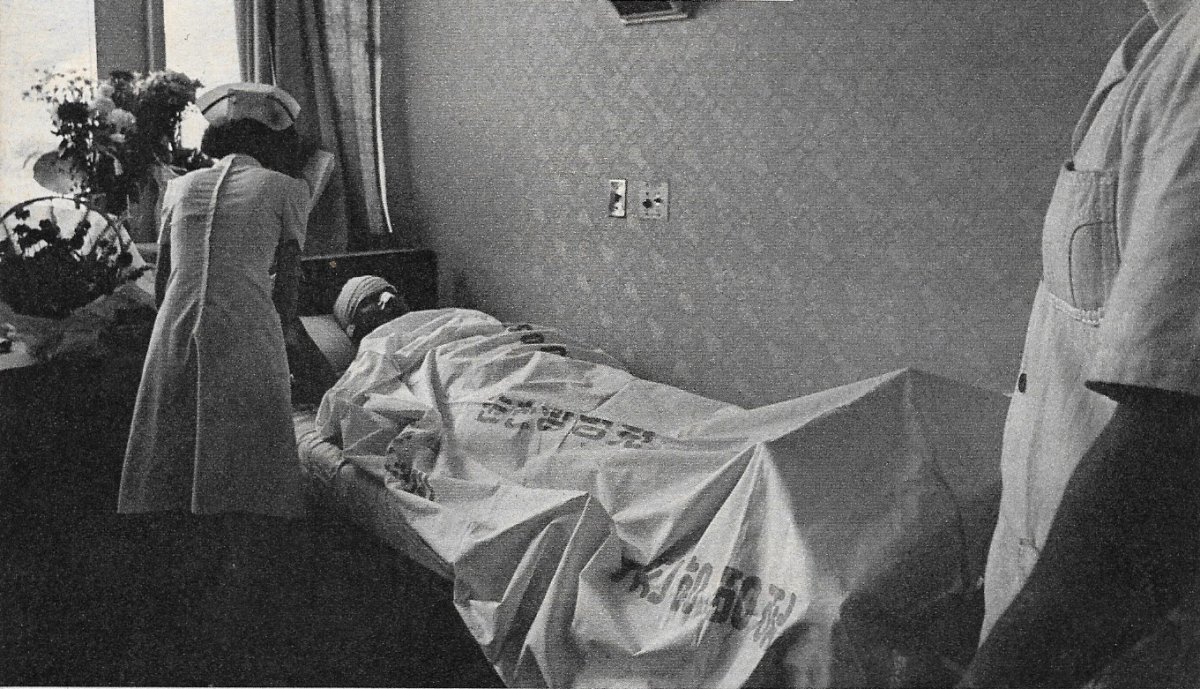
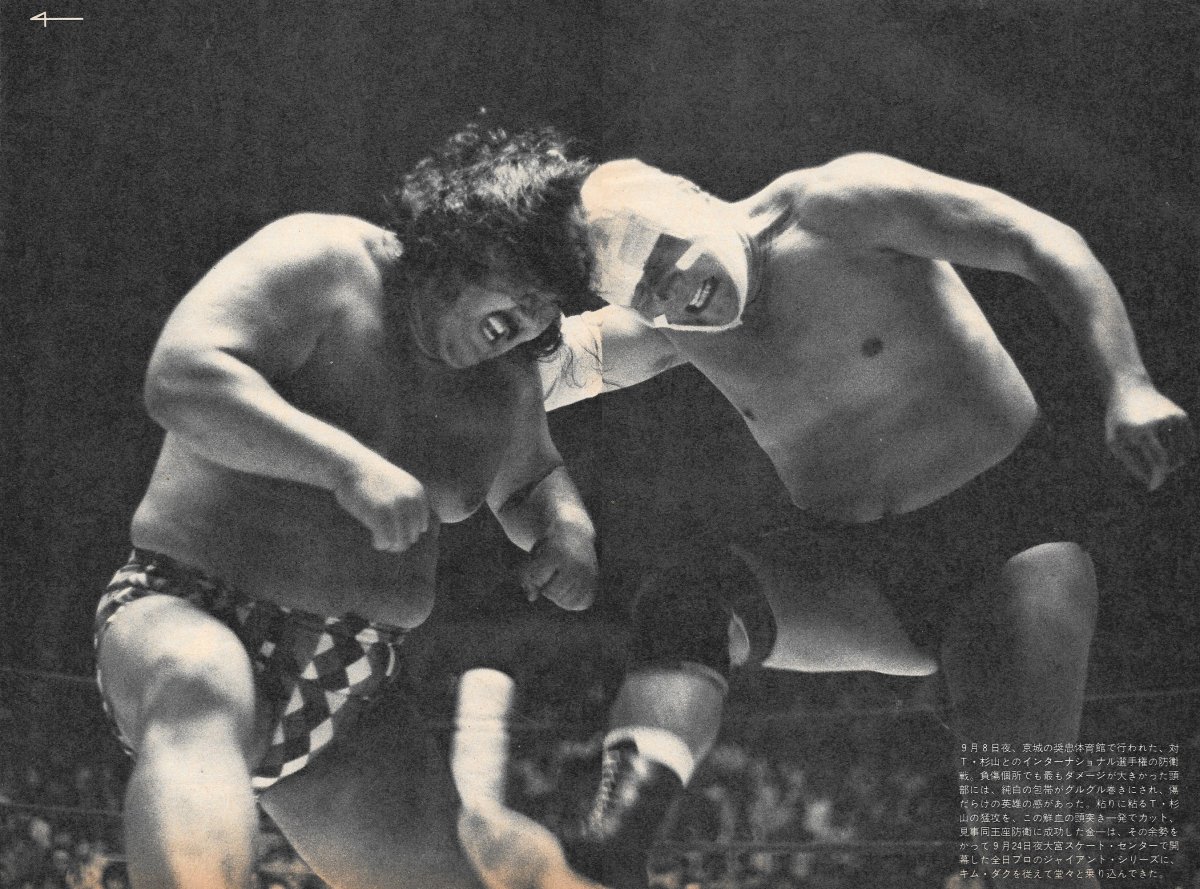
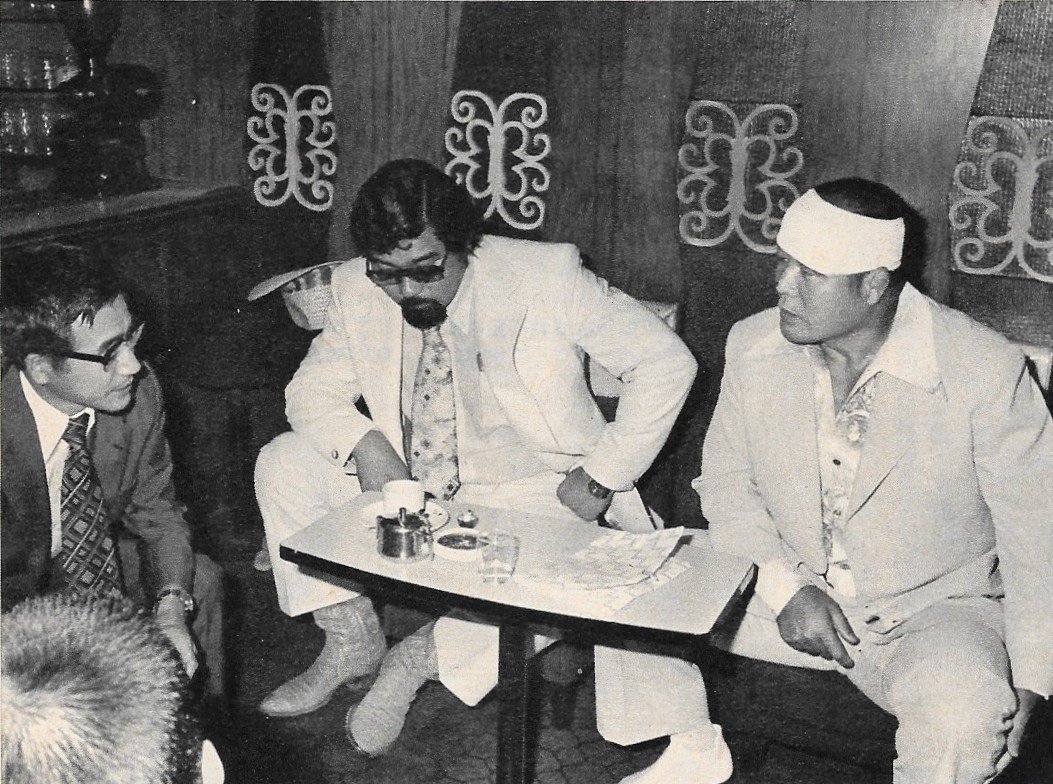
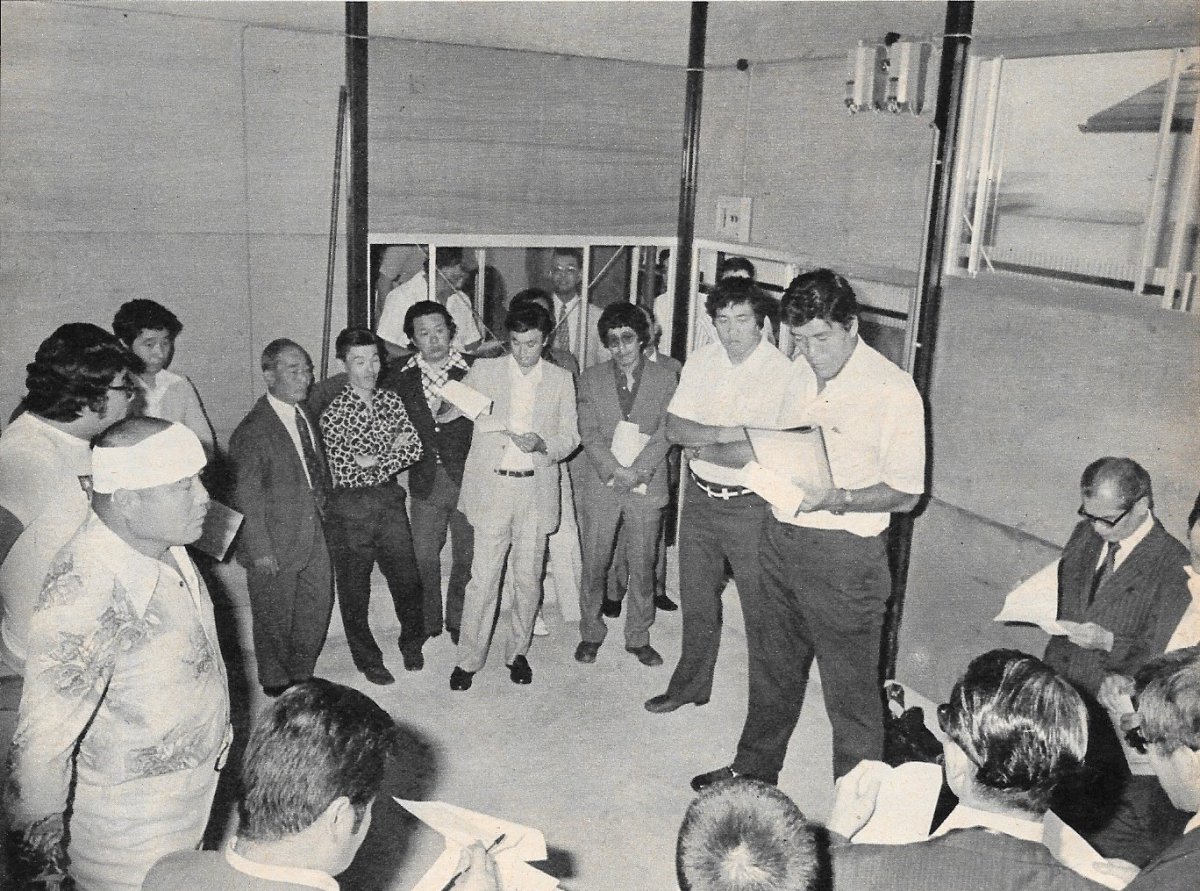
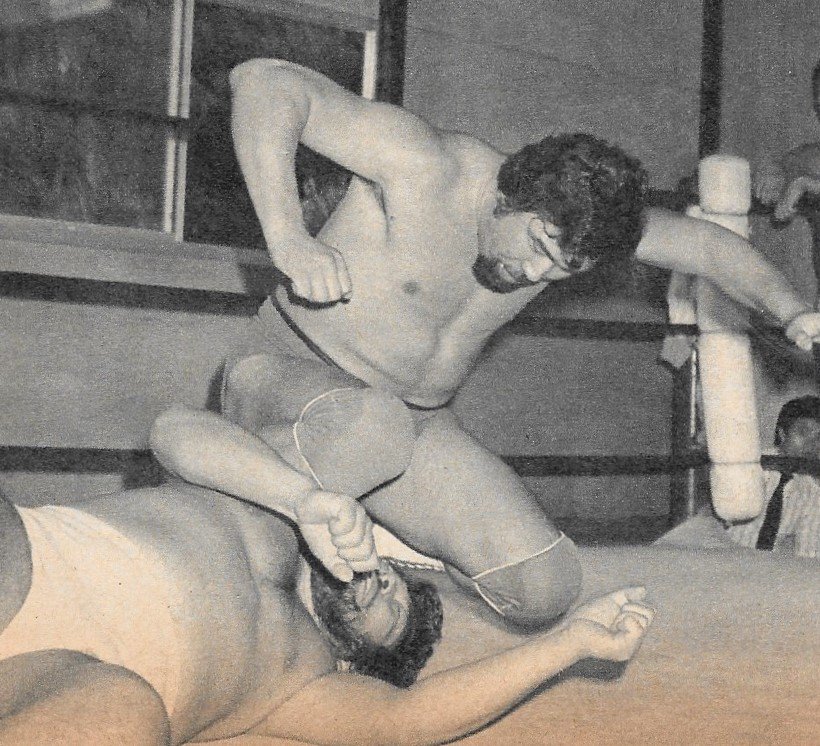 Oki's face lit up, and he turned his focus toward Tsuruta, who had been following Baba closely. Pointing at Toguchi, he said “Can't you even greet your senpai?” Toguchi was more than four years Tsuruta's senior. Tsuruta, however, who had been watching Oki's fighting and snapping at his mentor, glared silently at Oki and Toguchi. Meanwhile, Toguchi was dressed in trunks.
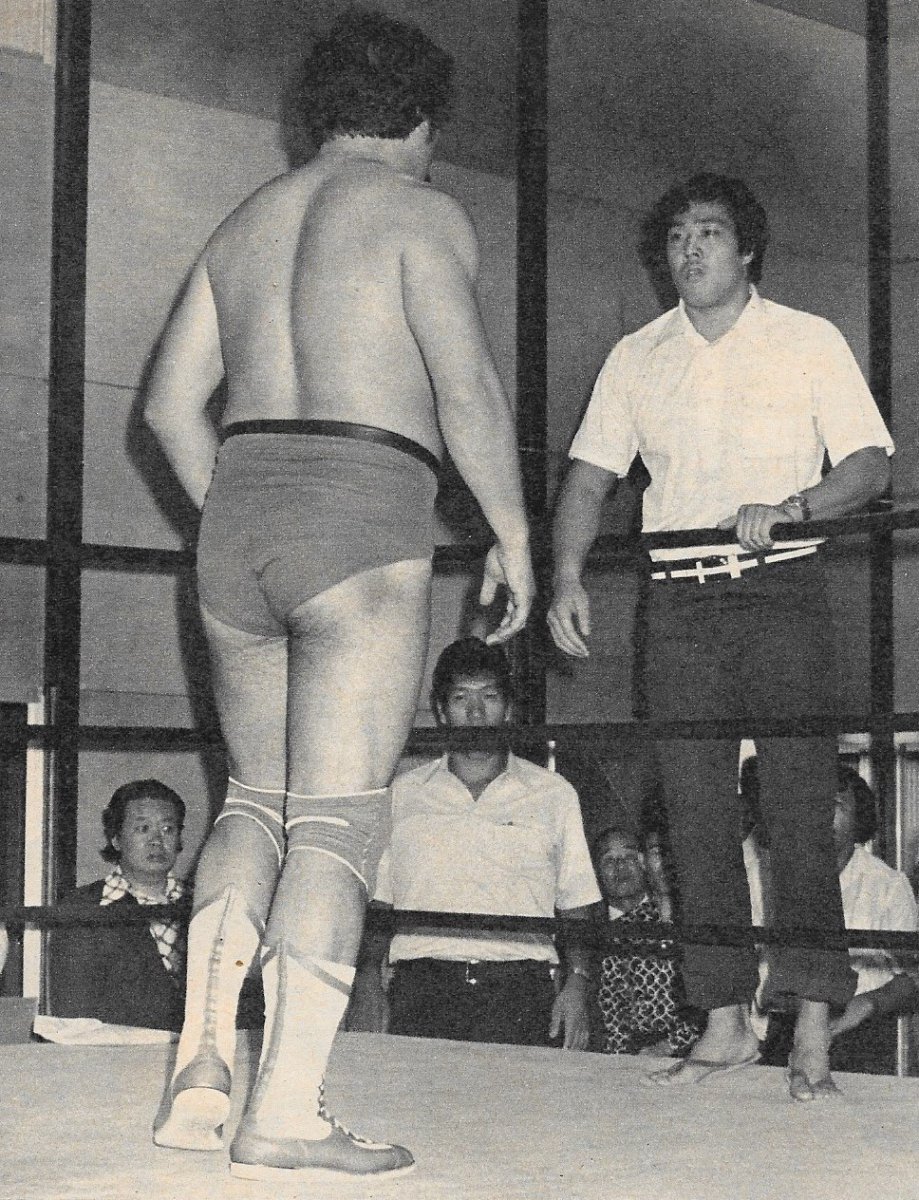
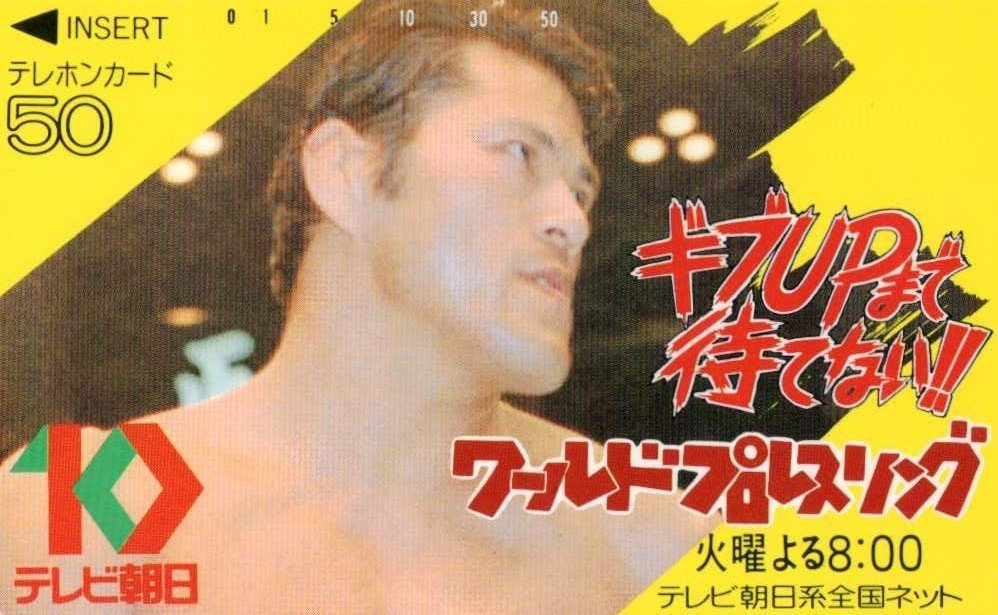

 I Can’t Wait Until The Give Up!! didn’t try to ease old fans into the new format. Kuniko Yamada and Kenichi Nagira were hosts, and other entertainers include idols LaSalle Ishii, Togumi Otoko and Kaoru Shimura, as well as actor and wrestling fan Reo Morimoto. The show was set up so that such celebrities could play to a studio audience and provide guest commentary on the wrestling. Segments in the premiere promoted Bam Bam Bigelow with a promo video and a segment comparing his weight to that of audience members, while Masa Saito entered the studio to challenge Inoki. All the while, though, the camera crew favored the celebrities in their close-ups. The backlash was immediate, as a dismal 5.7% debut fell to a 5.0% the next week. The studio and idol elements were soon dropped in favor of studio interview segments. It was after this change, though, that the most famous incident of the I Can’t Wait Until The Give Up!! experiment took place. Yamada interviewed Hiroshi Hase, a Japan Pro Wrestling recruit who had completed his debut excursion but had not yet debuted for NJPW. Kuniko asked a dumb question about whether a bleeding wrestler ceased to bleed when they returned to the waiting room (if I’m parsing it correctly, it seems to imply that she thought they used fake blood), and an agitated Hase snapped at her. While the likes of Inoki and Tatsumi Fujinami understood the difficulty of Yamada’s position, and they sympathized as her awareness of viewer backlash took a toll on her well-being, many others must have felt that Hase had spoken for them in that moment.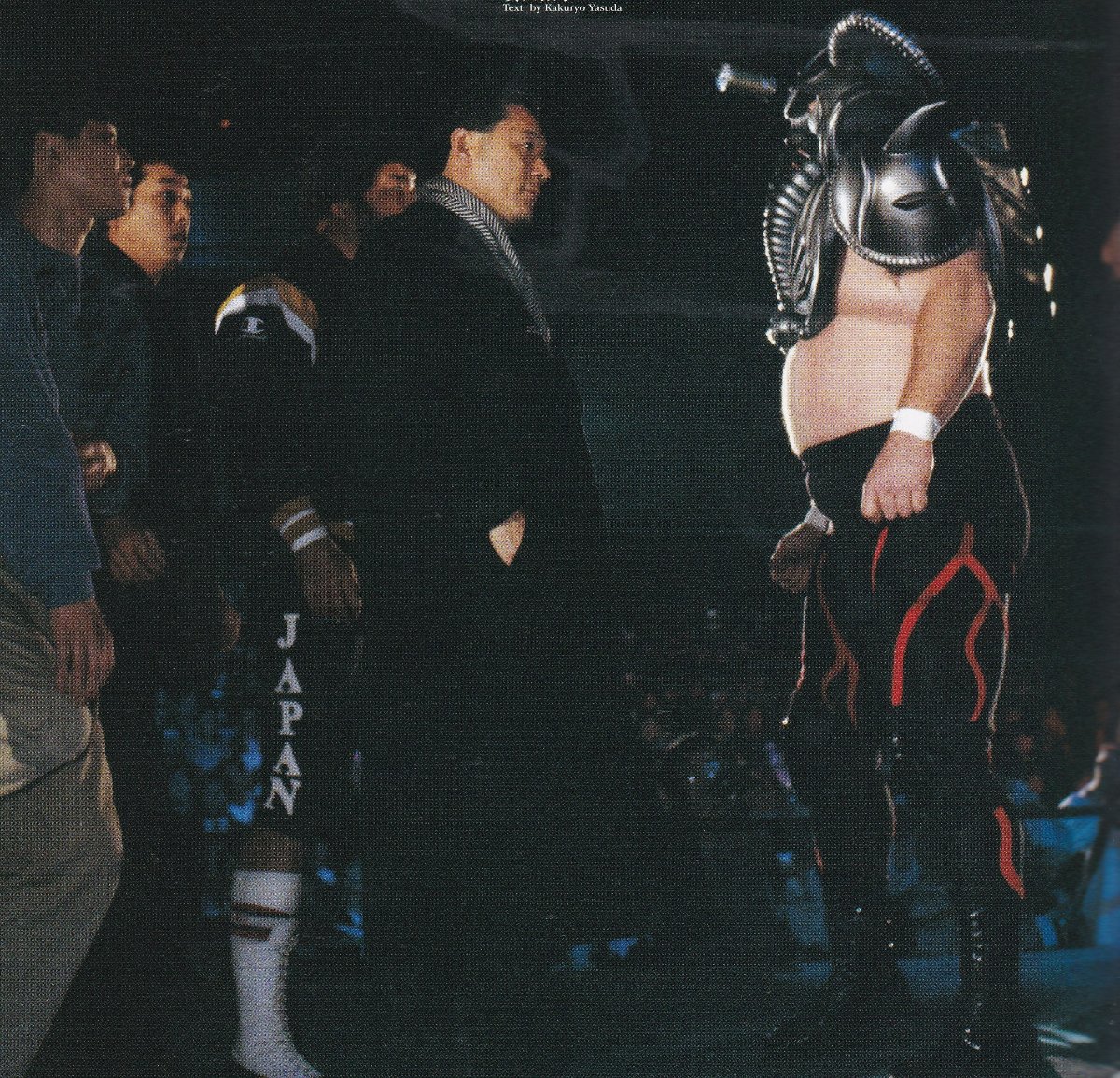
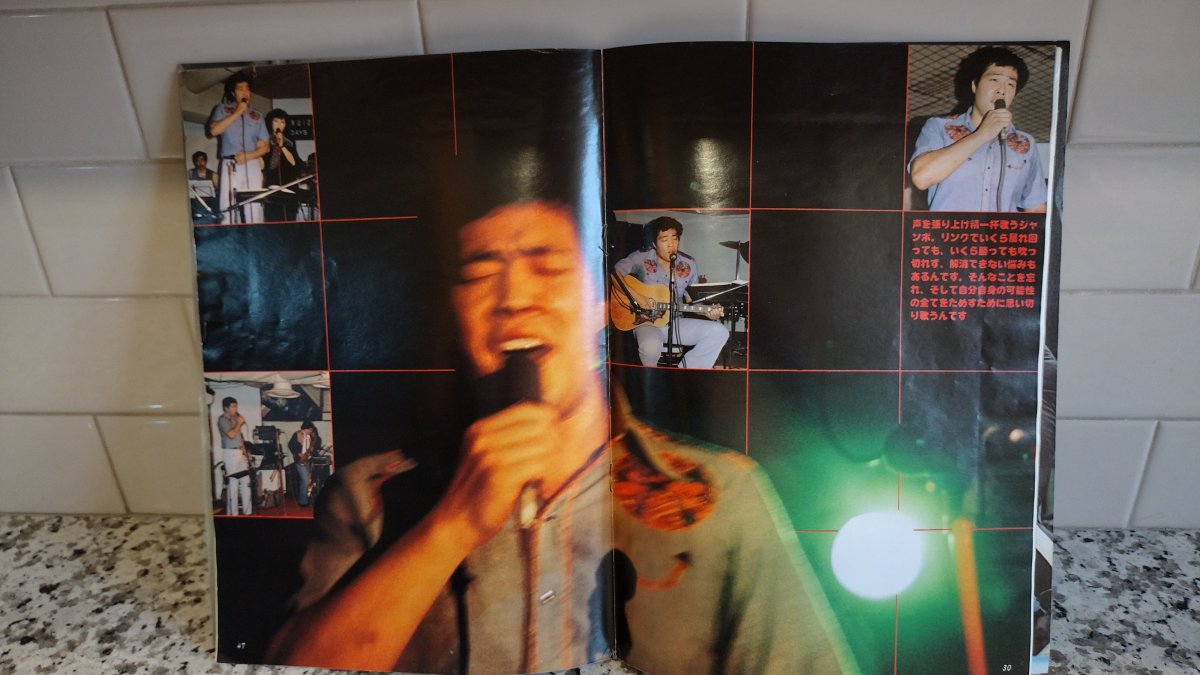
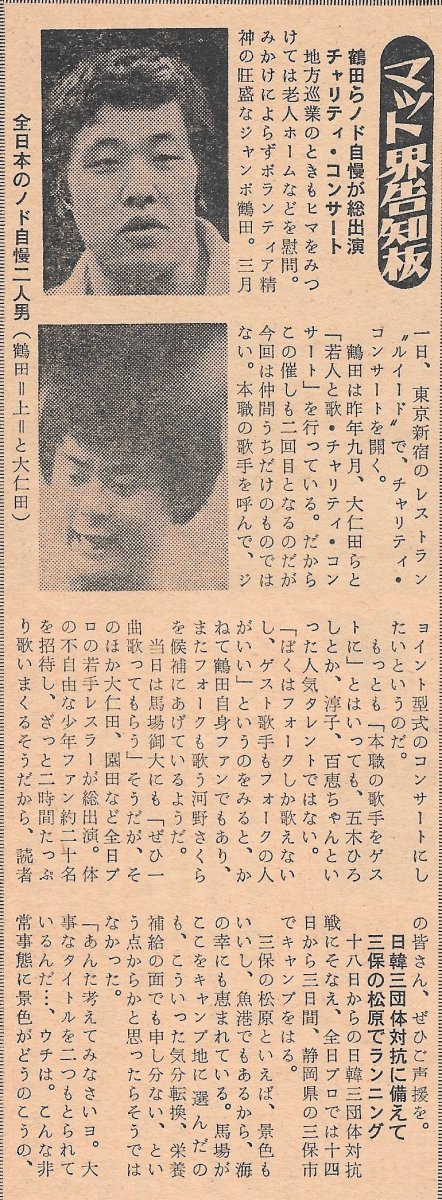
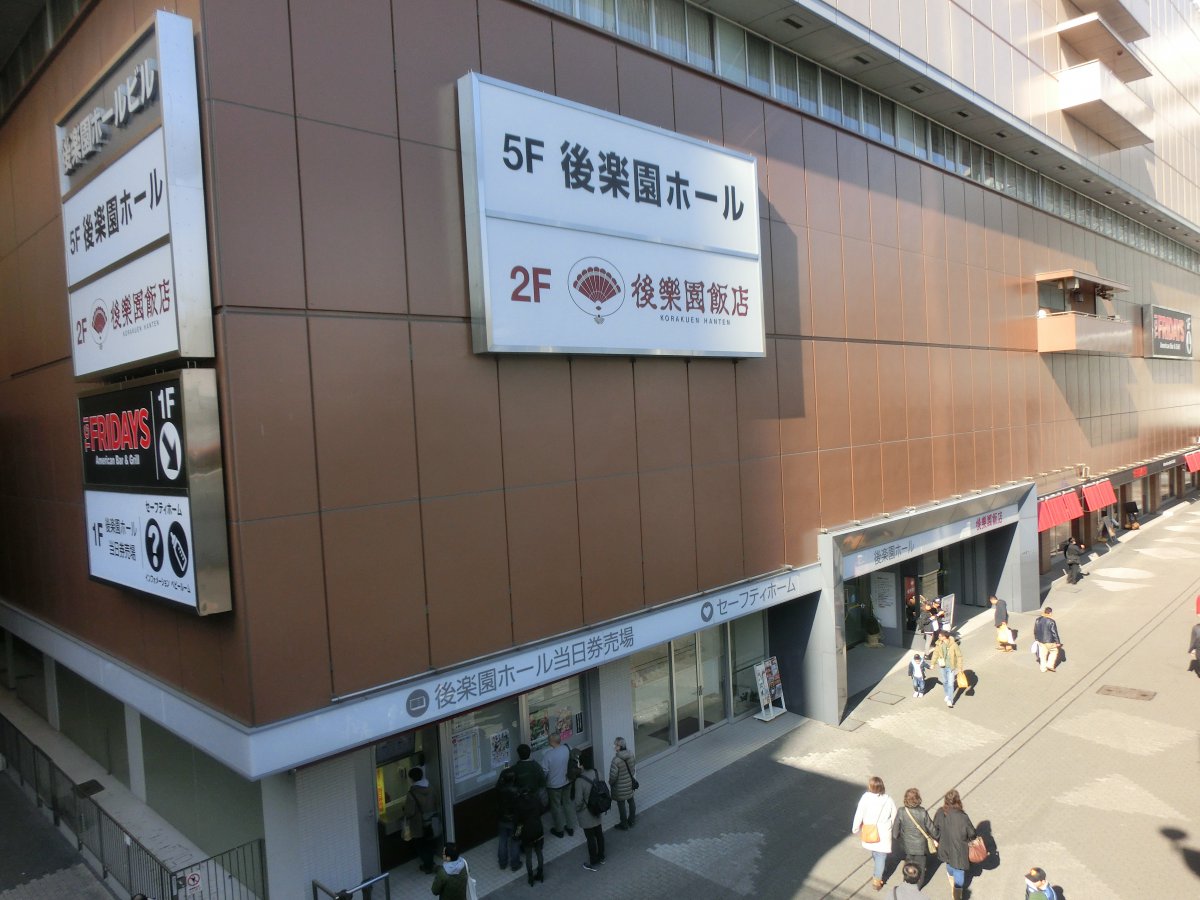
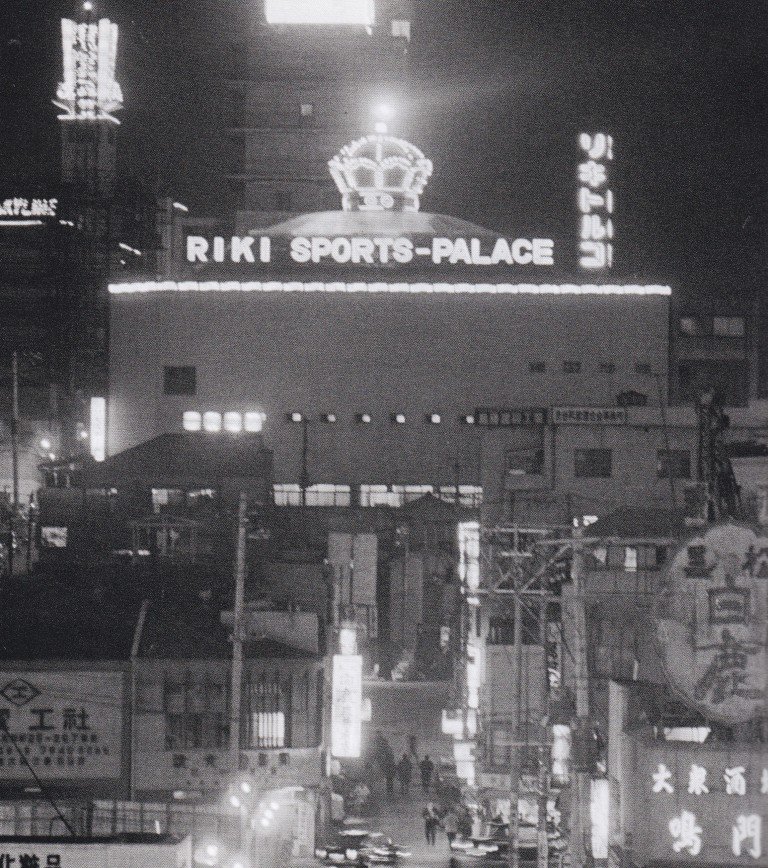
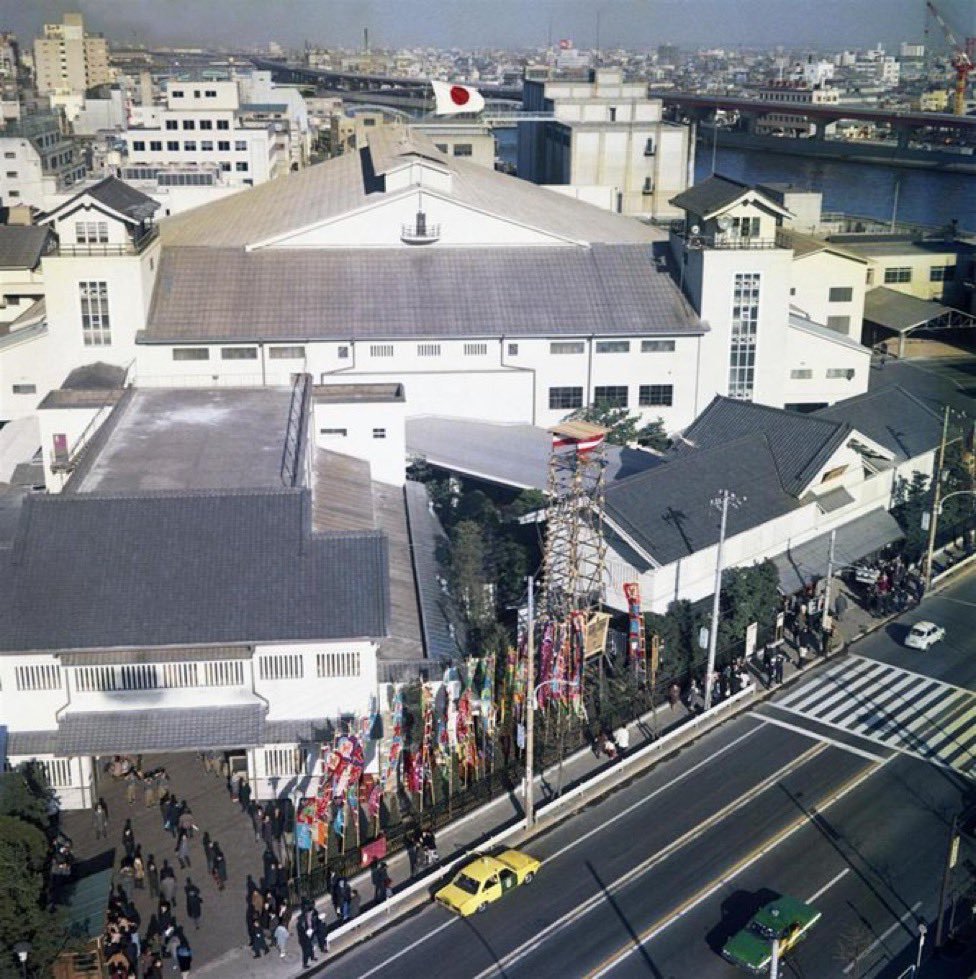

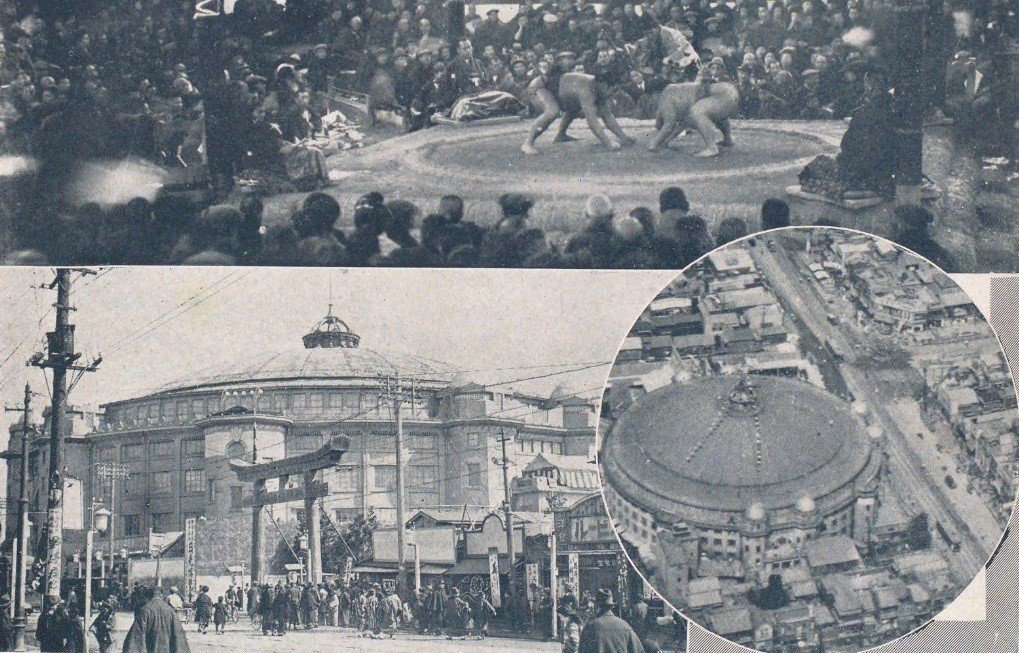
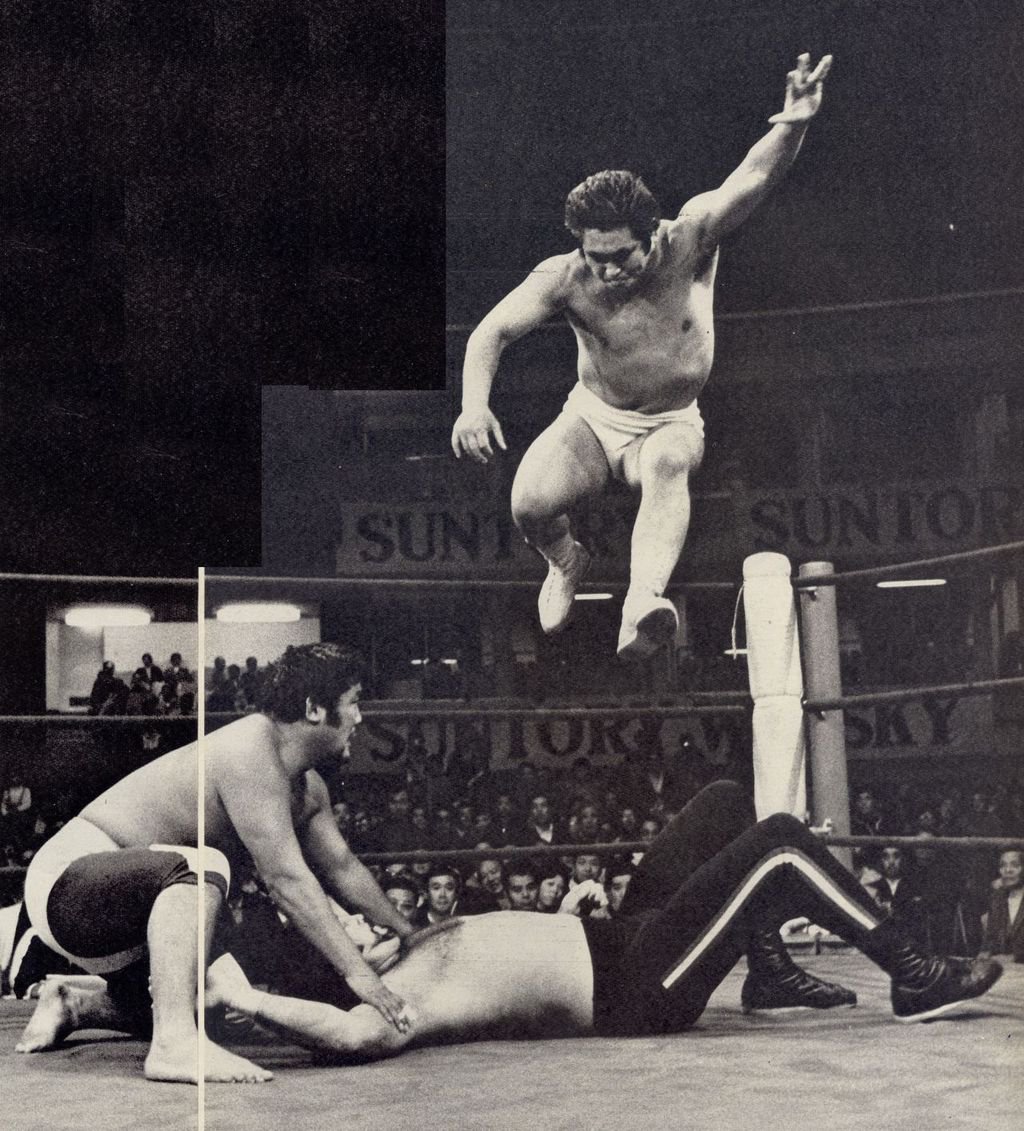
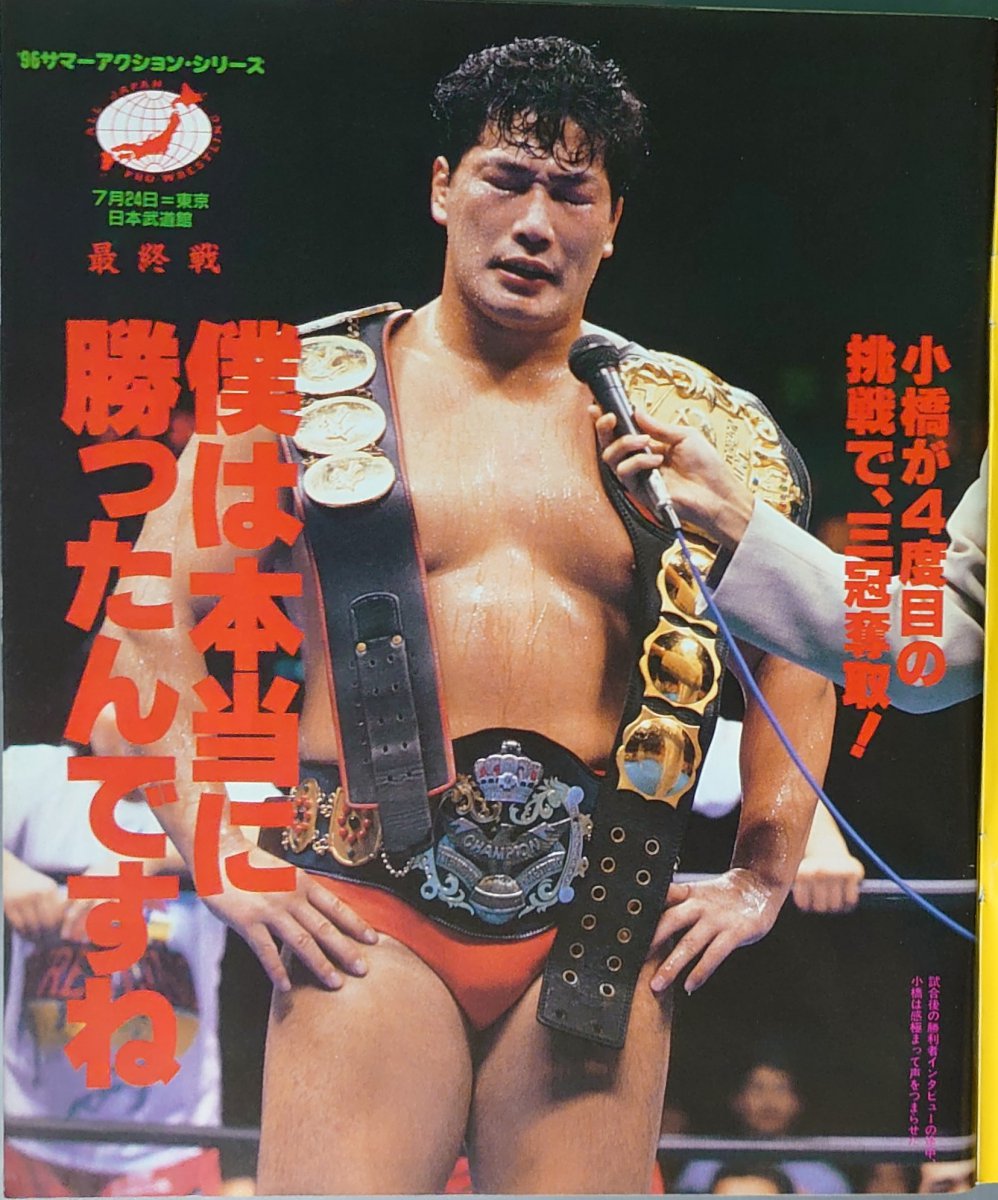
.jpg.a8333e18a29155a19ff6f1de9f7205da.jpg)

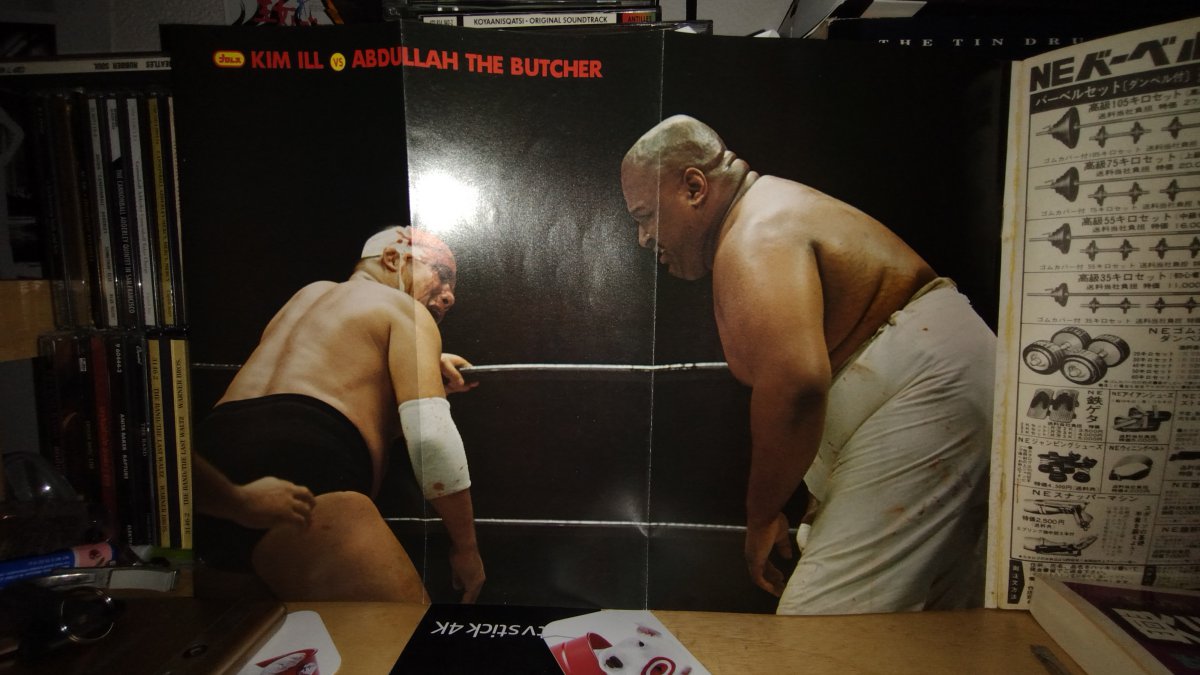
.jpg.de1ca8eb7d9a9dc65d38b864342adf6a.jpg)
.jpg.d37c92030dc7a186a24e16e1387a0f8c.jpg)
.jpg.33b5cd9da783eeeac66500747814101d.jpg)
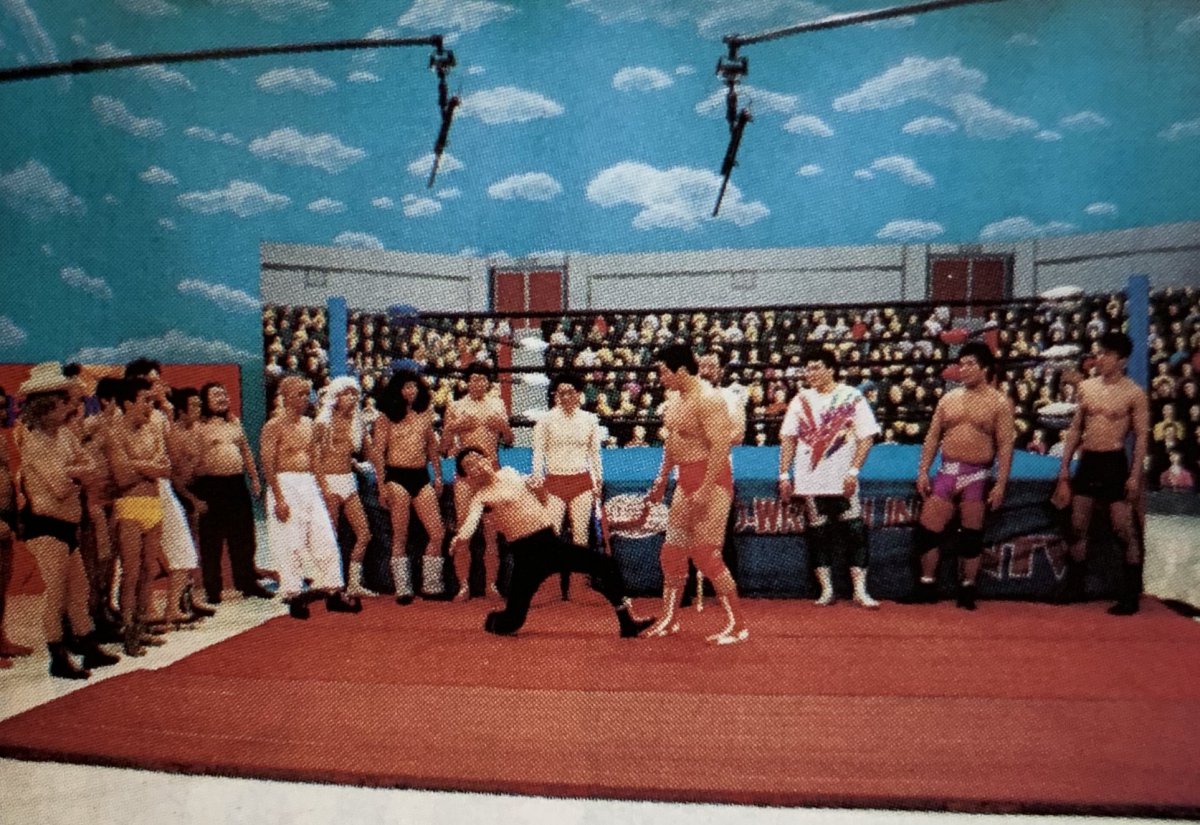
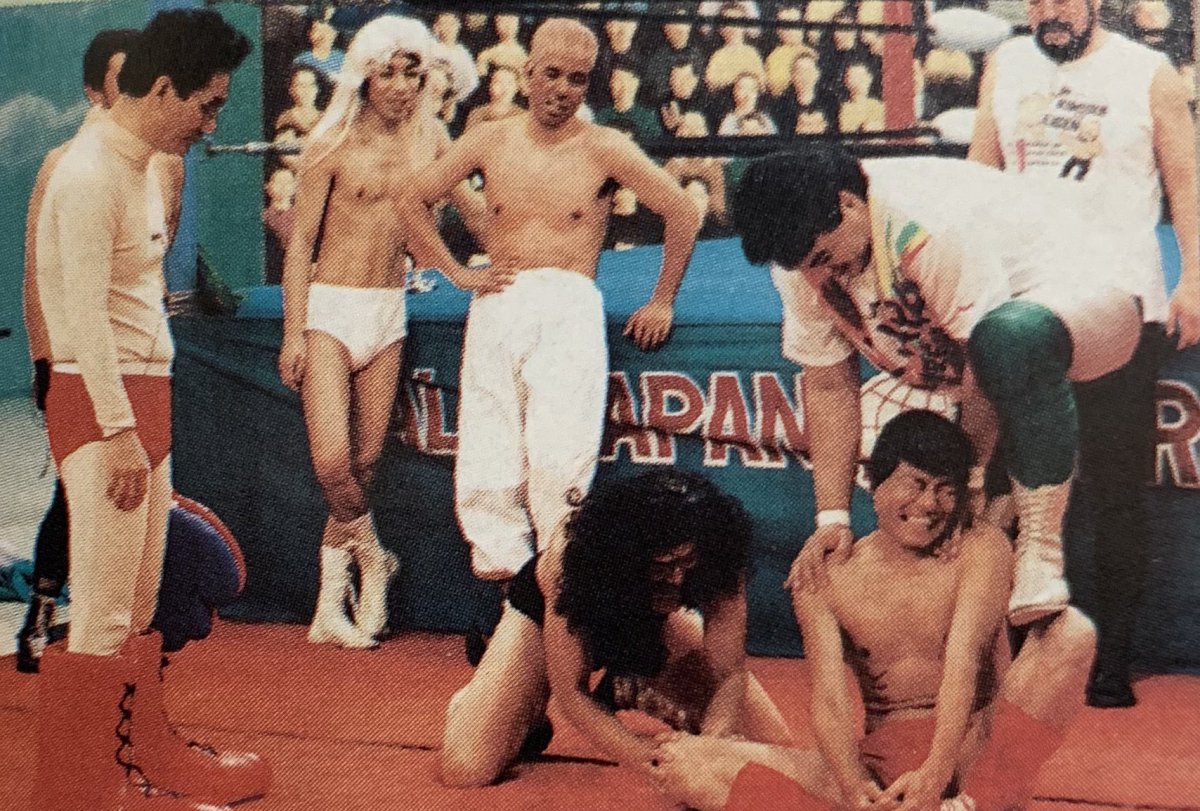
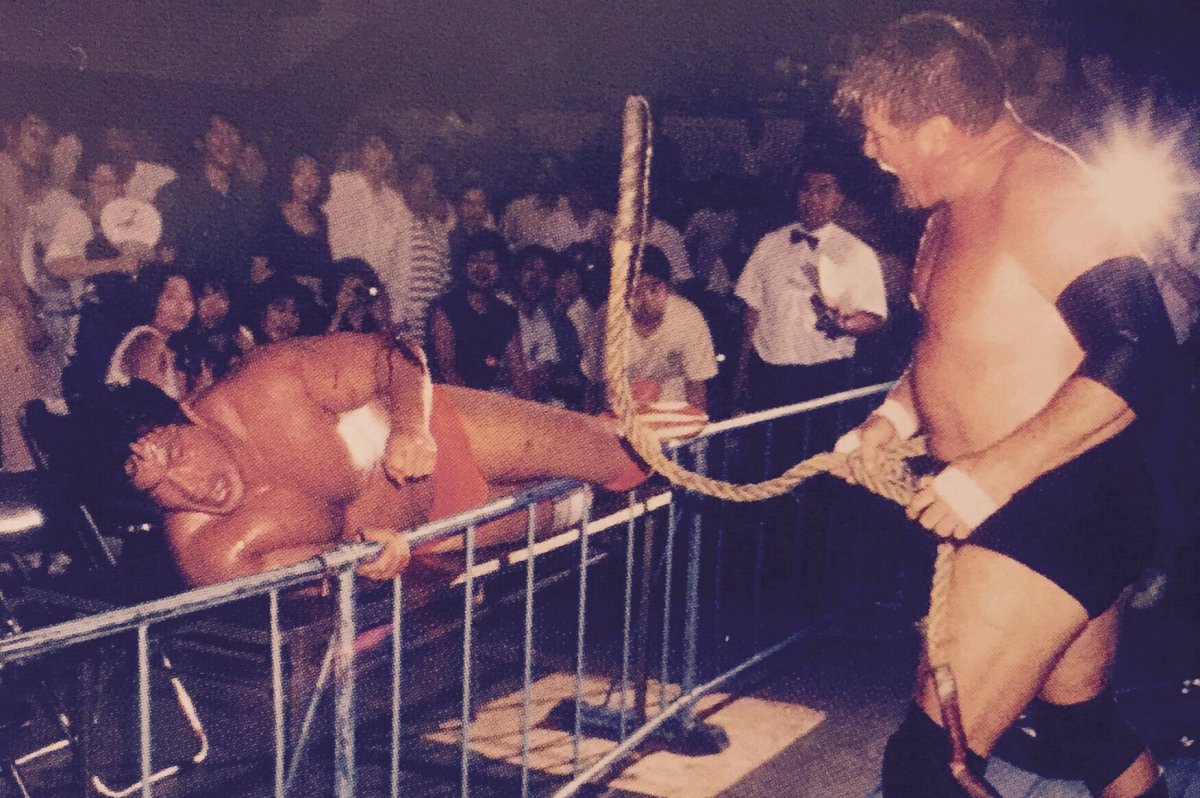

[Vintage Article, 1976] Kintaro Oki and Kim Duk challenge Baba and Tsuruta
in Puroresu History